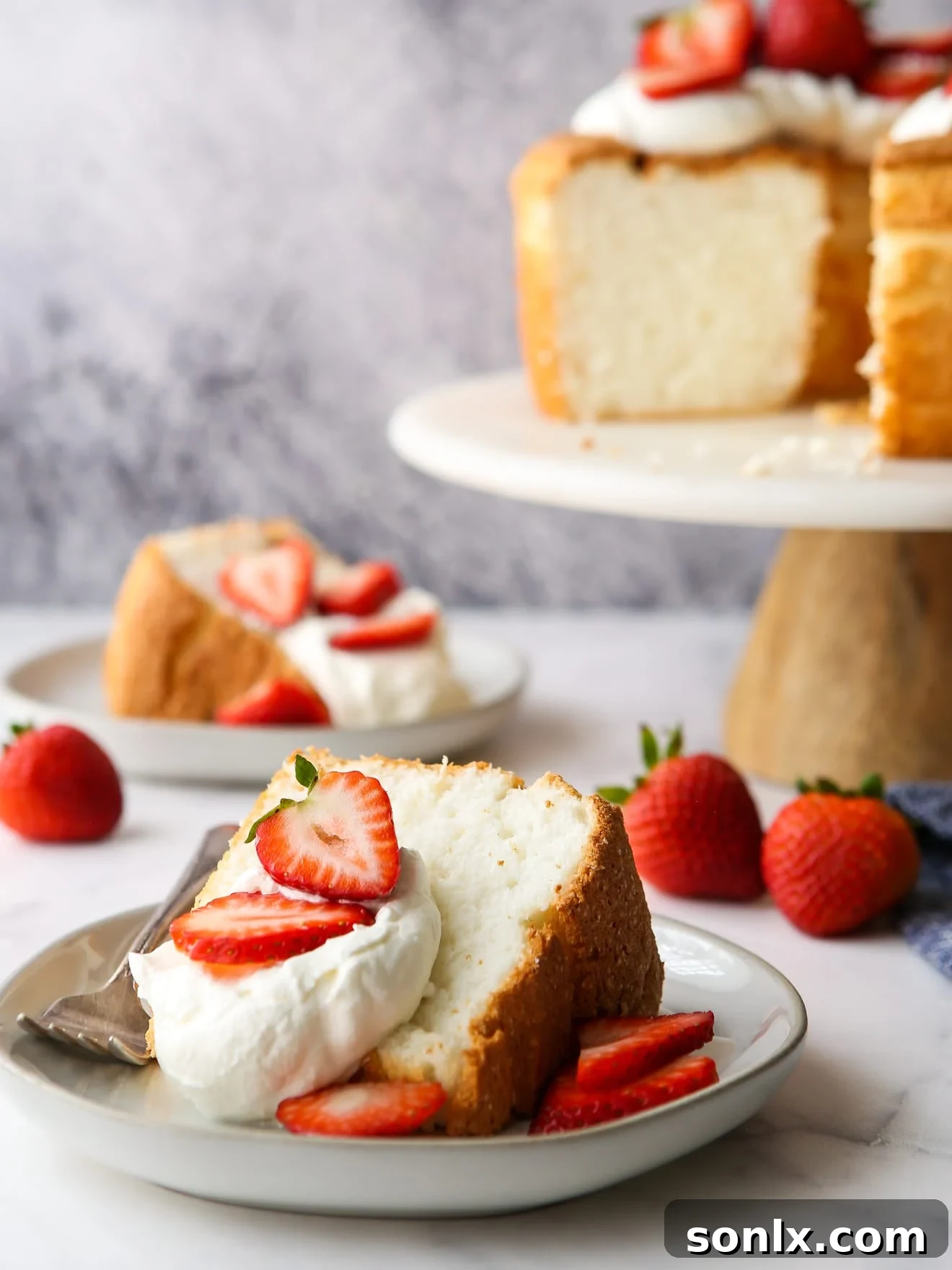
Angel food cake is more than just a dessert; it’s a classic culinary masterpiece renowned for its extraordinary lightness, delicate sweetness, and incredibly soft, spongy texture. Made almost entirely from whipped egg whites, this ethereal cake feels like biting into a cloud. Its subtle flavor makes it a versatile canvas for a myriad of toppings, with fresh whipped cream and vibrant berries often stealing the spotlight for the perfect light and refreshing treat. Prepare to discover the joy of baking this truly heavenly cake.
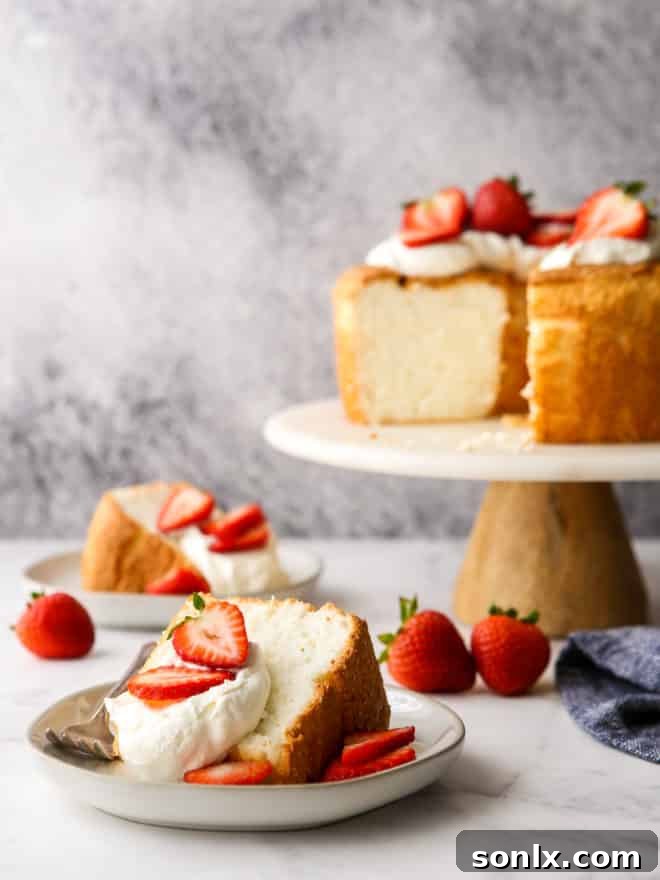
Baking the Perfect Angel Food Cake: Your Ultimate Guide to a Light & Fluffy Dessert
For many home bakers, the thought of tackling an Angel Food Cake from scratch conjures images of complex techniques and potential pitfalls. It’s often mentally filed under “too intimidating” due to its distinctive height and delicate structure. I confess, for a long time, I harbored similar reservations, never daring to attempt what seemed like a culinary Everest. Yet, like many challenges in the kitchen, the perceived difficulty often far outweighs the reality. Once you understand the fundamental principles and unique characteristics of this meringue-based cake, you’ll be astonished at how approachable and rewarding it truly is.
My inaugural attempt at baking Angel Food Cake left me utterly amazed by its simplicity. While it’s true that a specialized tube pan is a non-negotiable tool for achieving its iconic shape and consistent bake, the actual mixing and baking process is remarkably straightforward. This isn’t a cake that relies on butter, oil, or chemical leaveners; its spectacular rise and airy texture come solely from perfectly whipped egg whites. This unique construction sets it apart from traditional cakes, making it a delightfully light dessert that feels indulgent without being heavy. It’s an ideal choice for celebrating special occasions, serving after a rich meal, or simply enjoying a moment of pure, delicate sweetness.
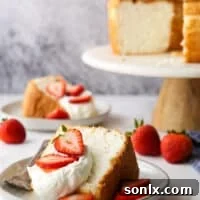
The hallmark of a truly great Angel Food Cake is its delicate flavor and signature soft, spongy texture. Each bite is a testament to its airy composition, a subtle sweetness that dances on the palate without overwhelming. While I find it most enchanting when crowned with a generous dollop of homemade whipped cream and a burst of seasonal strawberries, the beauty of this cake lies in its versatility. It welcomes a myriad of toppings, allowing you to tailor it to your preferences or the season. Let this guide empower you to bake an Angel Food Cake that will impress with its elegance and delight with its unparalleled lightness, proving that a heavenly dessert is well within your reach.
Seeking more delightful, airy treats? Dive into these fantastic variations: Angel Food Cake Cupcakes for individual servings, and the exotic Coconut Angel Food Cake for a tropical twist.
Table of Contents
- The Enduring Appeal of Angel Food Cake
- Essential Ingredients for Your Airy Masterpiece
- Mastering the Art of Angel Food Cake Baking
- Delectable Pairings: What to Serve with Angel Food Cake
- Common Questions About Angel Food Cake (FAQs)
- Expert Tips for a Flawless Angel Food Cake
- Your Go-To Angel Food Cake Recipe
The Enduring Appeal of Angel Food Cake
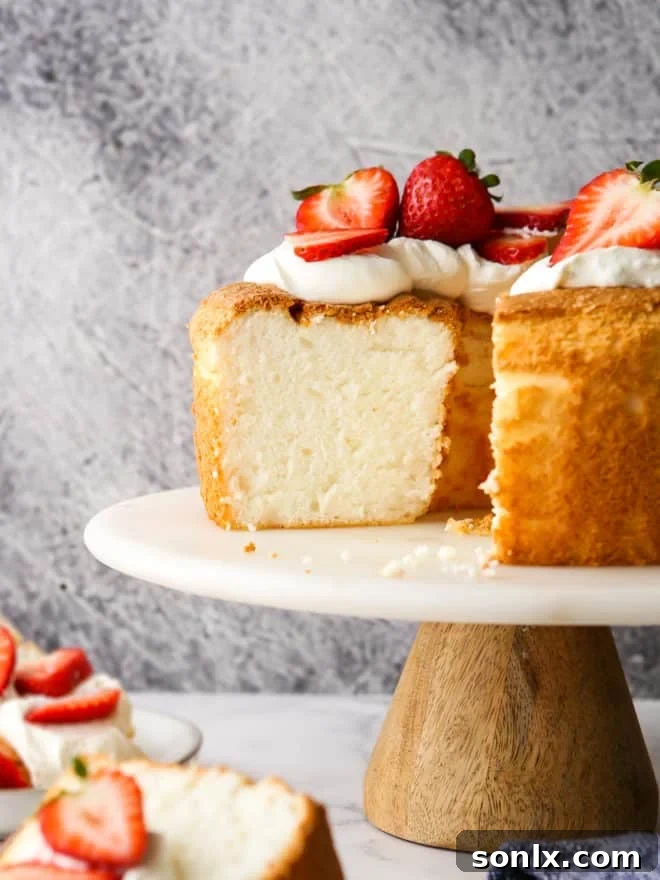
Angel food cake holds a special place in the pantheon of classic desserts, and for good reason. Its moniker, “angel food,” perfectly captures its extraordinary qualities: light, airy, and utterly heavenly. Unlike its denser counterparts, this cake contains no egg yolks, butter, or oil, relying solely on the power of whipped egg whites to create its magnificent structure and airy volume. This unique composition results in a dessert that is remarkably low in fat and cholesterol, making it a popular choice for those seeking a lighter indulgence.
Beyond its health-conscious appeal, the texture of angel food cake is truly unique. It boasts a springy, tender crumb filled with countless tiny air pockets, providing a delightful chew that is both delicate and satisfying. The flavor profile is subtly sweet, often enhanced by vanilla or almond extract, allowing it to pair beautifully with a wide range of fruit and cream toppings without being cloying. This makes it incredibly versatile for seasonal celebrations; think fresh berries in summer, poached pears in fall, or citrus segments in winter. Its visual elegance, with its characteristic high rise and golden crust, also makes it a showstopper on any dessert table. It’s not just a cake; it’s a testament to the magic that can be created with simple, pure ingredients and a precise technique.
Essential Ingredients for Your Airy Masterpiece
The success of your Angel Food Cake hinges on a few crucial ingredients, each playing a vital, specific role in achieving that signature light and ethereal texture. Understanding these roles will help you appreciate the precision required and ensure a perfect bake. Here’s a closer look at what you’ll need (you’ll find the full recipe with precise measurements at the end of this post):
- Cake Flour: This is arguably the most critical dry ingredient. Cake flour is milled from soft wheat and has a significantly lower protein content (around 7-8%) compared to all-purpose flour (10-12%). Less protein means less gluten development when mixed with liquids, resulting in an exquisitely tender, delicate, and fine crumb – exactly what you want in an Angel Food Cake. Do not substitute with all-purpose flour for best results.
- Granulated Sugar: Beyond providing sweetness, sugar plays a vital role in stabilizing the whipped egg whites, contributing to the cake’s structure, and helping it achieve that desirable golden-brown crust. It’s typically added in stages to ensure it dissolves fully without deflating the meringue.
- Egg Whites: The true hero of Angel Food Cake! These provide all the leavening. Fresh, room-temperature egg whites whip up to their maximum volume, creating the millions of tiny air cells that give the cake its remarkable lift and incredibly airy texture. Absolute cleanliness is paramount here – even a speck of yolk or grease can prevent them from whipping properly.
- Cream of Tartar: A common baking acid that acts as a stabilizer for egg whites. It helps them whip up faster, achieve greater volume, and, most importantly, maintains their stability, preventing them from collapsing during mixing and baking. It also contributes to the cake’s bright white color.
- Salt: A small amount of salt is essential for balancing the sweetness and enhancing the overall flavor profile of the cake, ensuring it’s not just sweet but deliciously well-rounded.
- Vanilla Extract: Infuses the cake with a classic, warm, and comforting aroma and flavor. For a slightly different twist, almond extract can also be used.
With these foundational ingredients and careful attention to their preparation, you’re well on your way to baking a magnificent Angel Food Cake.
Mastering the Art of Angel Food Cake Baking
While Angel Food Cake is unique in its composition and method compared to traditional butter cakes, the process itself is quite manageable. It demands attention to detail, particularly in the preparation of egg whites and the gentle incorporation of dry ingredients, but it’s far from intimidating once you understand the technique. As always, adhering closely to the recipe instructions will guide you to that coveted soft and spongy texture.
Let’s break down the essential steps to baking this delightful dessert, ensuring a confident and successful experience from start to finish!
- Meticulous Flour & Sugar Preparation: The Triple Sift: Start by preheating your oven to 300°F (150°C). This low, slow temperature is key for even baking and a tall rise. Now, for the flour: sift your cake flour *three times* into a bowl. This crucial step not only aerates the flour but also ensures an incredibly fine, lump-free texture, essential for the cake’s delicate crumb. After the triple sift, measure out two-thirds of the granulated sugar and sift it together with the already sifted cake flour one more time. This ensures uniform distribution and helps prevent any flour lumps in the final delicate batter.
- Whipping Egg Whites to Perfect Soft Peaks: In an impeccably clean, dry mixing bowl (preferably glass or metal, as plastic can retain grease), begin beating your room-temperature egg whites on medium speed. Beat until they become visibly frothy, resembling soap suds. At this stage, add the salt and cream of tartar. Increase the mixer speed to medium-high and continue beating until the egg whites just begin to form soft peaks. When you lift the whisk, the peaks should hold their shape briefly but gently curl or flop over at the tip. Gradually, and continuously beating, rain in the remaining granulated sugar, a tablespoon at a time. Continue beating until the egg whites achieve soft, glossy peaks – they should be firm enough to hold their shape when the whisk is lifted but still soft and pliable, not stiff or dry. Finally, gently mix in the vanilla extract until just combined.
- The Art of Gentle Folding: This is perhaps the most critical step for maintaining the cake’s airy volume. Sift about a quarter of your prepared flour-sugar mixture over the whipped egg whites. Using a large rubber spatula, carefully fold the dry ingredients into the egg whites. Use a cutting motion down through the center of the bowl, then sweep up from the bottom and fold over. Rotate the bowl as you go. Repeat this gentle folding process with the remaining flour-sugar mixture in three more separate additions, folding only until just incorporated. Overmixing will cause the delicate air pockets in the egg whites to collapse, leading to a dense and tough cake.
- Filling the Tube Pan (Ungreased is Key!): Carefully spoon the light and airy batter evenly into an *ungreased* 10×4-inch tube pan. It is absolutely vital not to grease the pan. The batter needs to cling to the sides of the pan as it bakes, allowing it to climb and achieve its impressive height. A greased pan would prevent this adhesion, resulting in a significantly flatter cake. Once the batter is in the pan, gently rap the pan on your counter a few times. This helps to release any large, trapped air bubbles, contributing to a more uniform and finer crumb.
- Baking to Golden Perfection: Carefully place the filled tube pan into your preheated 300°F (150°C) oven. Bake for approximately 1 hour and 15 to 20 minutes. The cake is done when the top is golden brown, springs back lightly when gently touched, and a wooden skewer or toothpick inserted into the center comes out completely clean. The relatively low baking temperature ensures the cake bakes through evenly without developing too dark a crust or drying out.
- The Crucial Upside-Down Cool: Invert Immediately! This step is non-negotiable for preserving the cake’s lofty height. As soon as the cake emerges from the oven, immediately invert the tube pan. Many tube pans are designed with small feet for this purpose. If your pan lacks feet, carefully invert it over the neck of a sturdy glass bottle (like a wine or soda bottle). This upside-down position prevents the warm, fragile cake from collapsing under its own weight as it cools and its structure sets. Allow the cake to cool completely in this inverted position for at least 2 hours, or until it has reached room temperature. Once fully cooled, use a thin, flexible serrated knife to carefully run around the outer edge and the inner core of the pan to release your magnificent, perfectly risen Angel Food Cake.
And there you have it! A perfectly baked Angel Food Cake, ready to be enjoyed and adorned with your favorite toppings.
Delectable Pairings: What to Serve with Angel Food Cake
Angel food cake, with its airy texture and subtle sweetness, is a dream to pair with a wide array of toppings. Its versatility means it can adapt to almost any flavor profile, making it a perfect dessert for any season or occasion. While it’s delightful on its own, adding a complementary topping elevates it to an unforgettable experience. Here are some delectable suggestions to inspire your culinary creativity:
- Classic Whipped Cream: A cloud of freshly whipped cream or a richer, lightly sweetened Chantilly cream frosting is a timeless pairing. The light, creamy texture perfectly complements the cake without weighing it down. For an extra touch, infuse the cream with a hint of vanilla bean or orange zest.
- Fresh Berries and Sliced Fruits: This is arguably the most popular and visually appealing choice. A vibrant medley of strawberries, raspberries, blueberries, blackberries, or sliced peaches, kiwi, and mango adds natural sweetness, a pleasant tartness, and a burst of color. Consider tossing berries with a touch of sugar and lemon juice to bring out their juices.
- Rich Chocolate Ganache or Hot Fudge: For the ultimate indulgence, a warm, glossy drizzle of chocolate ganache or a spoonful of hot fudge creates a luxurious contrast in both flavor and texture. The intensity of the chocolate plays beautifully against the cake’s delicate lightness.
- Tangy Lemon Curd: The bright, zesty, and slightly tart flavor of homemade lemon curd provides a wonderful counterpoint to the cake’s sweetness. It adds a sophisticated layer of citrusy delight and a smooth, creamy texture.
- Ice Cream or Sorbet: A simple scoop of vanilla bean ice cream, a refreshing raspberry sorbet, or even a decadent coconut or pistachio ice cream can transform a slice of angel food cake into a more substantial and satisfying dessert.
- Fruit Sauces and Coulis: Elevate your cake with homemade fruit sauces like raspberry coulis, strawberry compote, or a warm cherry sauce. These add moisture, intense fruit flavor, and an elegant finish.
- Nutty Crunch: For added texture, a sprinkle of lightly toasted slivered almonds, chopped pistachios, or shredded coconut can provide a delightful crunch and complementary flavor.
Don’t hesitate to get creative with seasonal ingredients and personal preferences. The beauty of Angel Food Cake is its adaptability, allowing you to craft a personalized dessert experience every time.
Common Questions About Angel Food Cake (FAQs)
While technically possible, using all-purpose flour will significantly alter the desired texture of your Angel Food Cake. Cake flour has a lower protein content, which results in less gluten development and thus a much more tender, delicate, and airy crumb. All-purpose flour will create a denser, tougher, and more rubbery cake that lacks the characteristic melt-in-your-mouth lightness. For optimal results and that true “angelic” texture, cake flour is indispensable.
“Soft peaks” refers to a stage in whipping egg whites where they have gained considerable volume and appear opaque and glossy. When you lift the whisk, the peaks that form will hold their shape, but their tips will gently curl or flop over rather than standing rigidly upright. This stage indicates enough air has been incorporated, but the whites are still pliable and easy to fold, which is crucial for gently incorporating dry ingredients without deflating the batter.
Yes, an ungreased tube pan with a removable bottom is essential for a successful Angel Food Cake. The central tube allows heat to circulate more evenly, ensuring the cake cooks through without the edges drying out. More importantly, the ungreased, tall sides provide a surface for the delicate batter to cling to and climb as it rises. Without this adhesion, the cake would simply collapse under its own weight, resulting in a flat, dense texture. Using a regular cake pan or a greased pan will not yield the desired lofty, airy result. Look for a good quality tube pan in the bakeware section of most kitchen stores or shop for one online.
Baking an Angel Food Cake typically leaves you with about 12-14 egg yolks, which is a considerable amount! Don’t let them go to waste. They are perfect for enriching other dishes. I highly recommend using them to make a batch of homemade lemon curd (which uses about 10 yolks), an incredibly delicious and versatile topping for your angel food cake or other desserts. Other fantastic uses include crème brûlée, homemade ice cream, hollandaise sauce, carbonara pasta, or a rich pastry cream for tarts.
Angel Food Cake holds up remarkably well at room temperature. If it’s still in its tube pan, you can simply leave it uncovered for a few days to maintain its unique texture. Once removed from the pan or if it’s already sliced, store it loosely covered with plastic wrap or under a cake dome. This prevents it from drying out. For longer storage, Angel Food Cake freezes beautifully. Wrap it tightly in two layers of plastic cling wrap, then an outer layer of aluminum foil, and it can be frozen for up to a month. Thaw at room temperature for several hours before serving.
Several factors can lead to a less-than-perfect Angel Food Cake. Common reasons for collapse or denseness include: 1) Over-folding the batter, which deflates the delicate whipped egg whites. 2) Greasing the tube pan, preventing the batter from climbing. 3) Egg whites not being whipped to the correct consistency (either under-whipped or over-whipped). 4) Opening the oven door too early during baking, causing a sudden temperature drop. 5) Not inverting the cake immediately after baking to cool. 6) Contamination of egg whites with even a tiny speck of yolk or grease. Reviewing each step carefully will help identify potential issues.
baking tip:Why does Angel Food Cake need to cool upside-down?
Many tube pans are specifically designed with small feet around their edges for this crucial purpose. If your pan doesn’t have these feet, a simple and effective workaround is to invert the pan (with the cake still inside) over the neck of a sturdy bottle, such as a wine or soda bottle, ensuring the cake is suspended and can cool without succumbing to gravity.
Expert Tips for a Flawless Angel Food Cake
Achieving a perfectly light and lofty Angel Food Cake is simpler than you might imagine, especially with these insider tips and tricks:
- Bring Egg Whites to Room Temperature: This is a golden rule for successful meringues. Cold egg whites won’t whip up to their maximum volume and will take significantly longer to reach the desired consistency. Separate your eggs when they’re cold (as they’re easier to separate cleanly), then allow the whites to sit at room temperature for 30-60 minutes before you begin whipping. This allows the proteins to relax, resulting in a more voluminous and stable meringue.
- Master Flawless Egg Separation: The cardinal rule of Angel Food Cake is absolute zero contamination. Even a minuscule trace of egg yolk (fat) in the whites will prevent them from whipping up properly, compromising the cake’s rise and texture. Employ a three-bowl method: one for separating a single yolk, one for depositing the clean white, and a larger bowl for collecting all the pristine whites. This prevents an entire batch from being ruined by a single broken yolk. Learn how to separate eggs here for the best results.
- Gentle Folding is Paramount: Once your egg whites are perfectly whipped, the flour mixture must be incorporated with the utmost gentleness to preserve as much air as possible. Overmixing is the enemy of Angel Food Cake, as it rapidly deflates the meringue, leading to a dense, tough texture. Use a large rubber spatula and a light, consistent hand, employing a “cut and fold” motion. Here’s a great visual guide on how to fold ingredients into each other properly.
- Never Grease the Pan: This tip is counterintuitive to almost every other cake recipe, but it is critical here. The delicate batter needs to “climb” the ungreased sides of the tube pan as it bakes to achieve its impressive height and airy structure. A greased pan would cause the batter to slip down, resulting in a significantly flatter and denser cake. Trust the process!
- Alternative to a Tube Pan (Use with Caution): While a dedicated tube pan is highly recommended for ideal results, if you find yourself without one and are eager to bake, there are makeshift solutions. Check out this clever hack for creating a temporary tube cake pan at home using a regular round cake pan and an oven-safe bottle or can in the center. While it may not yield identical results, it can work in a pinch.
- The Right Tools for Cutting and Serving: Due to its delicate nature, Angel Food Cake requires a specific approach when cutting. To cleanly release the cake from the pan, use a thin, flexible serrated knife or a special angel food cake knife. Gently run it around the outer and inner edges of the pan. A serrated knife is also your best tool for slicing the cake itself, as its saw-like edge prevents tearing the tender crumb that a straight blade might cause.
- Optimal Storage for Freshness: Angel Food Cake remains wonderfully fresh and delightful at room temperature for several days. If you’ve baked it in the pan, it’s often best left uncovered in the pan to maintain its light texture. Once removed or sliced, store it under a cake dome or in an airtight container to prevent it from drying out. For longer preservation, this cake freezes beautifully. Wrap it tightly in two layers of plastic cling wrap and then an outer layer of aluminum foil; it will keep well for up to a month. Thaw at room temperature for several hours before indulging.
- Check Your Oven Temperature: Angel Food Cake relies on precise and consistent oven temperature for its delicate rise and even bake. Ovens can often run hotter or cooler than their display indicates. Consider investing in an inexpensive oven thermometer to verify your oven’s accuracy. Adjust your oven temperature as needed to match the recipe’s requirements, ensuring perfect baking conditions.
Your Go-To Angel Food Cake Recipe
Angel Food Cake
12
servings
15 minutes
1 hour
15 minutes
2 hours
3 hours
30 minutes
Pin Recipe
Leave a Review
Ingredients
-
1 cup
(113 grams)
cake flour -
1 ⅔ cup
(333 grams)
granulated sugar -
1 ¾ cup
(425 grams)
egg whites
(from about 13 eggs) -
½ teaspoon
salt -
1 teaspoon
cream of tartar -
½ teaspoon
vanilla -
Strawberries and whipped cream for serving
, optional
Prevent your screen from going dark
Equipment
Instructions
-
Preheat your oven to 300°F (150°C). Ensure your oven rack is in the lower-middle position for optimal heat distribution.
-
In a medium bowl, sift the cake flour three times to ensure it is incredibly light and free of lumps. Then, measure out ⅔ cup of the granulated sugar and sift it together with the flour one more time into a clean bowl. Set this flour-sugar mixture aside.
-
In a large, impeccably clean, and dry mixing bowl (glass or metal is highly recommended), begin beating the room-temperature egg whites on medium speed until they become frothy and appear like soap suds. Add the salt and cream of tartar. Increase the speed to medium-high and continue beating until the egg whites just begin to form soft peaks – when you lift the whisk, the peaks should hold their shape briefly before gently curling over. Gradually add the remaining granulated sugar, a tablespoon at a time, continuing to beat until the egg whites hold soft, glossy peaks. Finally, beat in the vanilla extract until just combined. Be careful not to over-beat the egg whites beyond soft peaks.
-
Gently sift about a quarter of the prepared flour-sugar mixture over the whipped egg whites. Using a large rubber spatula, carefully fold the dry ingredients into the egg whites using a cutting motion through the center and sweeping up from the bottom, then folding over. Repeat this gentle process with the remaining flour-sugar mixture in three more additions, folding only until just incorporated. The goal is to retain as much air as possible in the batter.
-
Carefully spoon the delicate batter into an ungreased 10 x 4 inch angel food cake tube pan. Smooth the top gently with your spatula. Lightly rap the pan on your counter a few times to release any large air bubbles trapped within the batter. Bake for approximately 1 hour and 15 minutes to 1 hour and 20 minutes, or until the top is golden brown, springs back when lightly touched, and a wooden skewer or toothpick inserted into the center comes out completely clean.
-
Immediately upon removing from the oven, invert the cake pan. If your tube pan has small feet, rest it on them. Otherwise, carefully invert the pan (with the cake still inside) over the neck of a sturdy glass bottle to keep the cake suspended upside-down. This crucial step prevents the cake from collapsing as it cools. Allow the cake to cool completely in this inverted position for at least 2 hours, or until it has reached room temperature. Once fully cooled, use a thin, flexible serrated knife to carefully run around the outer edge and the inner tube of the pan to release the cake.
-
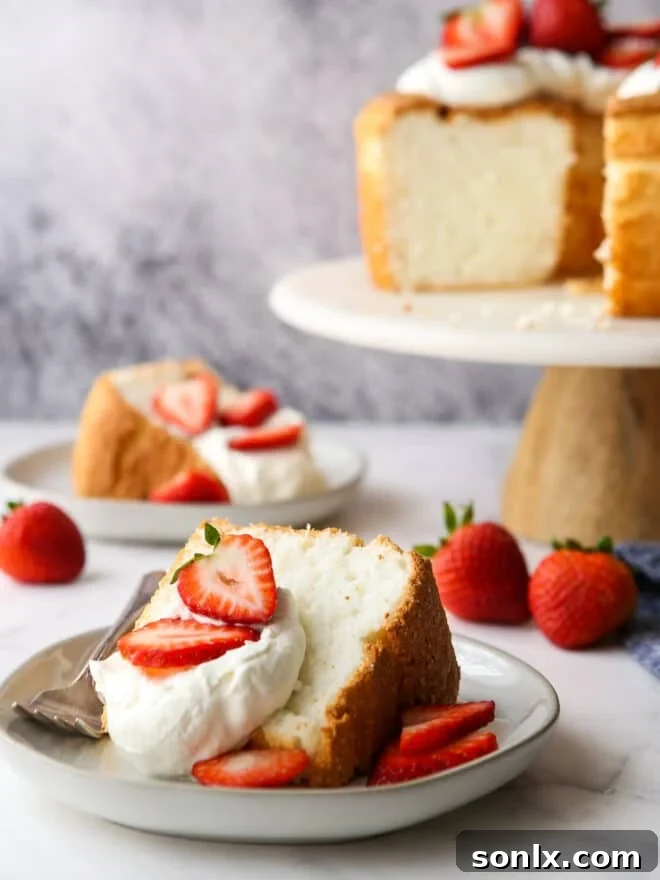
Slice the cooled cake with a serrated knife and serve immediately with your favorite toppings, such as fresh strawberries and a generous dollop of homemade whipped cream, or as desired. Enjoy your homemade, perfectly light, and airy Angel Food Cake!
Video
Notes
For even more detailed tips, troubleshooting advice, and in-depth information about how to achieve the perfect Angel Food Cake, please refer to the main article above.
This recipe has been thoughtfully adapted from The Gourmet Cookbook to ensure perfect results.
Carbohydrates: 36g,
Protein: 5g,
Fat: 1g,
Saturated Fat: 1g,
Sodium: 156mg,
Potassium: 109mg,
Fiber: 1g,
Sugar: 28g,
Calcium: 4mg,
Iron: 1mg
Have you tried this recipe?
I’d love to hear about it! Leave a rating and review below, or take a photo and tag it on Instagram @completelydelicious with #completelydelicious.
This recipe was originally published in June 2014. While the core recipe remains consistent, this updated post features enhanced photos, expanded tips, and more comprehensive information to help you achieve baking success with this timeless classic.