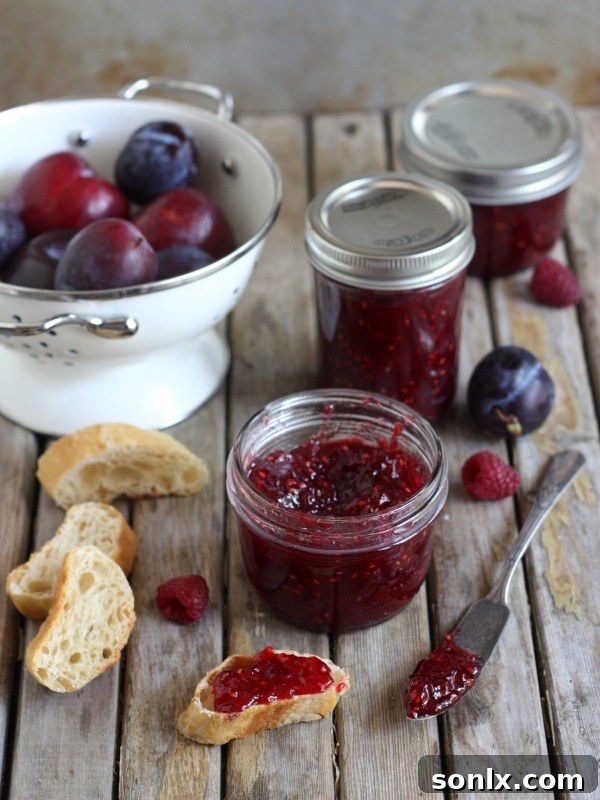
Raspberry Plum Jam: A Taste of Summer, Jarred for Year-Round Enjoyment
There’s something truly magical about homemade jam – a sweet, vibrant taste that instantly transports you back to sun-drenched orchards and bustling farmer’s markets. This easy raspberry plum jam isn’t just a recipe; it’s a celebration of summer’s bounty, a spoonful of pure joy that can be savored long after the warm days have faded. Imagine spreading this luscious, jewel-toned preserve on your morning toast, swirling it into yogurt, or pairing it with your favorite cheeses. It’s an indulgence that keeps the spirit of summer alive, all year round.

Embracing the Art of Jam Making: A Personal Journey
For many, the summer season isn’t just about vacations and outdoor adventures; it’s also “jam season.” I fondly recall the summer of 2013, a year that marked my deep dive into the delightful world of preserving. What started as a timid exploration quickly blossomed into a passionate pursuit, transforming my kitchen into a fragrant haven of bubbling fruits and clinking jars. While I’ve grown comfortable with various canning techniques, jam making has always held a special place in my heart. Its simplicity, the creative freedom to experiment with countless flavor combinations, and the immense satisfaction of transforming fresh produce into shelf-stable treasures are unparalleled.
Among the many wonderful jams I’ve crafted over the years, this raspberry plum jam stands out as a true masterpiece. It’s a testament to the joy of embracing traditional methods, a labor of love that yields a product far superior to anything you might find on a grocery store shelf. Each jar captures not just the flavors, but also the memories of warm summer days, ready to be rediscovered with every spread.

The Perfect Harmony: Why Plums and Raspberries?
The decision to marry plums with raspberries in a jam isn’t just a whim; it’s a stroke of culinary genius, offering a unique blend of flavors and practical advantages. Firstly, this combination results in a truly distinctive taste profile. The rich, deep sweetness and slight tartness of ripe plums perfectly complement the bright, tangy zest of raspberries. This creates a complex, multi-layered flavor that is intensely fruity and wonderfully balanced – a far cry from the often one-dimensional jams found in commercial settings. When you present this jam, it unequivocally declares its origin: homemade with love.
Beyond the exquisite taste, there’s a clever economic benefit. Raspberries, as delightful as they are, can be quite expensive, especially when purchased in the quantities needed for jam making. By incorporating plums, which are often more affordable and bountiful, you can effectively “stretch” the vibrant raspberry flavor without compromising on taste. Plums provide a fantastic base, adding body and natural pectin, allowing the precious raspberry notes to shine through while keeping your ingredient costs down. This thoughtful pairing ensures that every jar is bursting with intense fruit flavor, making it both a gourmet delight and a smart choice for your pantry.
The Gift of Homemade Goodness
Another aspect of jam making that I deeply cherish is its potential for thoughtful gifting. There’s a special kind of warmth that comes from sharing something you’ve created with your own hands. Rows of beautifully labeled jars, filled with this shimmering raspberry plum jam, make for exquisite presents during the holidays, birthdays, or as a simple token of appreciation. I always ensure to have a dedicated stockpile in my pantry – some reserved for my own year-round enjoyment, and others eagerly awaiting their destiny as heartfelt gifts for friends and family. It’s a wonderful way to extend the generosity and vibrant flavors of summer well into the colder months, spreading cheer one delicious spoonful at a time.

Making Jam Without Commercial Pectin: A Natural Approach
Many traditional jam recipes rely on commercial pectin to achieve that perfect gelled consistency. While effective, it’s important to understand that pectin is a completely natural polysaccharide, occurring abundantly in the cell walls of fruits. Essentially, adding extra pectin is often unnecessary if you harness the power of nature. Fruits like plums are naturally high in pectin, making them excellent candidates for a pectin-free jam.
The process of coaxing out this natural pectin and allowing the jam to gel on its own is a more time-honored method. It typically involves a slightly longer cooking time, as you reduce the fruit mixture until the pectin molecules naturally link together, creating the desired thick texture. This extended simmering allows the fruit flavors to concentrate and deepen, resulting in a more intense, pure, and truly exceptional tasting final product. It’s a testament to the idea that sometimes, the simplest methods yield the most profound results.
Understanding Pectin Content in Fruits
Not all fruits are created equal when it comes to their natural pectin content. Some fruits are naturally rich in pectin, making them ideal for pectin-free jams, while others have lower levels and might require a bit more attention or clever pairings. High-pectin fruits include apples, cranberries, lemons, and, of course, plums. These fruits have enough natural gelling agents to set a jam beautifully with just sugar and heat.
On the other hand, fruits with a lower pectin content, such as apricots, cherries, peaches, pears, rhubarb, and most berries (though raspberries have a moderate amount), can be trickier to get to gel on their own. For these, you might either choose to add commercial pectin, or, preferably, combine them with a high-pectin fruit to naturally boost the gelling power. The inclusion of plums in this raspberry jam recipe is a perfect example of this strategy, ensuring a lovely set without any added commercial pectin. The lemon juice also plays a crucial role, as pectin requires acidity to properly gel, further aiding in the natural setting process.
Achieving the Perfect Set: Testing the Jelling Point
One of the most common questions in jam making is, “How do I know my jam has jelled correctly?” Achieving the perfect jelling point is crucial for a successful jam – you want it thick enough to spread beautifully, but not so stiff that it becomes rubbery. Fortunately, there are several reliable methods to test for the jelling point without needing any special equipment beyond what you already have in your kitchen.
Three Essential Jelling Point Tests:
- The Freezer Test (or Cold Plate Test): This is arguably the most popular and easiest method. Before you start cooking, place a small plate or two in your freezer to chill thoroughly. When you believe your jam is nearing its setting point (it will appear thick and glossy), remove the pot from the heat. Spoon a small amount of hot jam onto one of the cold plates. Return the plate to the freezer for 1-2 minutes. After chilling, retrieve the plate and gently push the edge of the jam with your finger. If it wrinkles and holds its shape, your jam has reached the jelling point. If it’s still runny, continue cooking and re-test.
- The Sheeting Test (or Spoon Test): This method requires a little more experience but is very effective. Dip a cold metal spoon into the hot jam, scooping up a small amount. Hold the spoon horizontally and allow the jam to cool slightly (about 30 seconds). Then, tilt the spoon, allowing the jam to drip off. Initially, it will drip in individual drops. As the jam approaches the jelling point, the drops will coalesce and “sheet” off the spoon in a single, thick sheet, or form two distinct drops that run together.
- The Temperature Test: While not foolproof on its own, using a candy thermometer can be a helpful guide, especially when combined with other tests. Jam typically reaches its setting point when it reaches a temperature of 220°F (104°C) at sea level. This temperature indicates that enough water has evaporated for the pectin to begin forming a gel. Remember that altitude affects boiling points, so subtract 2°F (1°C) for every 1,000 feet above sea level. Always verify with a physical test as well, as sugar content and fruit ripeness can slightly alter the ideal temperature.
By using these methods, you can confidently determine when your raspberry plum jam has achieved its ideal consistency, ensuring a delightful texture every time. Patience and observation are key!
★
★
★
★
Raspberry Plum Jam
8
half-pint jars
10
mins
30
mins
10
mins
50
mins
Pin Recipe
Leave a Review
Ingredients
- 1 lb raspberries (454 grams)
- 3 lbs plums , sliced and pits removed (leave skins on) (1360 grams)
- 5 cups granulated sugar (1000 grams)
- ½ cup bottled lemon juice (120 ml)
- Zest of 1 orange
Instructions
-
Combine the raspberries, sliced plums, sugar, lemon juice, and orange zest in a large heavy-bottomed pot. Place over medium-high heat and stir frequently as the sugar dissolves and the fruit begins to release its juices.
-
Continue to cook, stirring frequently as the jam simmers and thickens. Skim any foam off of the surface with a spoon. This foam is natural but can affect the clarity of your finished jam.
-
(Optional) Removing Plum Skins: While the jam is simmering, you may notice some plum skins separating. These can be removed with a spoon or tongs for a smoother texture. This step is purely aesthetic and based on personal preference.
-
(Optional) Removing Raspberry Seeds: If you prefer a jam with fewer raspberry seeds, simply place a fine-mesh strainer over the pot. Ladle about one-third to one-half of the simmering mixture into the strainer and press it through with a spatula back into the pot. Discard the collected raspberry seeds from the strainer. Repeat if desired for an even smoother jam.
-
Once the jam has reduced and thickened to the desired consistency (refer to the jelling point tests above), remove it from the heat. Carefully ladle the hot jam into sterilized jars, leaving about ¼ inch of headspace. Top each jar with a lid and secure with a screw-on ring.
-
Process the filled jars in a boiling water bath for 10 minutes (for altitudes up to 1,000 feet). If you are at an elevation of 5,000+ feet, process for 15 minutes, adjusting for your specific altitude. After processing, carefully remove the jars from the water bath and allow them to cool completely on a towel-lined counter, undisturbed, for 12-24 hours.
-
Check that the lids have sealed properly by pressing down into the center of each one. The lid should be concave and should not flex or move when pressed. Any jars that have not sealed should be stored in the refrigerator and consumed within 2-3 weeks. Store properly sealed jam in a cool, dry, dark place like a pantry and enjoy within 1 year for best quality.
Notes
Nutrition Information
Carbohydrates: 152g,
Protein: 2g,
Fat: 1g,
Saturated Fat: 1g,
Sodium: 2mg,
Potassium: 368mg,
Fiber: 6g,
Sugar: 145g,
Vitamin A: 606IU,
Vitamin C: 37mg,
Calcium: 24mg,
Iron: 1mg
American
Snack
Annalise Sandberg
Have you tried this recipe?
I’d love to hear about it! Leave a rating and review below, or take a photo and tag it on Instagram @completelydelicious with #completelydelicious.
Beyond the Jar: Serving Suggestions and Creative Pairings
Once you’ve mastered the art of making this exquisite raspberry plum jam, the possibilities for enjoying it are endless. While it’s undeniably divine spread simply on a piece of warm, buttered toast or a fresh scone, don’t limit its potential. This jam’s vibrant flavor and delightful texture make it incredibly versatile in the kitchen.
Consider pairing it with artisanal cheeses on a charcuterie board – its fruity sweetness provides a wonderful counterpoint to savory and salty flavors. It can transform a simple bowl of Greek yogurt or oatmeal into a gourmet breakfast. For dessert, swirl it into vanilla ice cream, use it as a filling for tarts and pastries, or even as a glaze for roasted meats like pork or duck to add a touch of sweet and tangy complexity.
Feeling adventurous? Experiment with variations! A pinch of cinnamon or a tiny dash of almond extract can enhance the stone fruit notes of the plums. For an extra citrusy kick, you could even add a little more orange zest or a hint of lime. Each small alteration opens up a new world of flavor, allowing you to personalize this already fantastic jam to your unique preferences.
A Year-Round Indulgence
Making your own raspberry plum jam is more than just a culinary task; it’s a rewarding journey that connects you to the seasons, the bounty of nature, and the simple pleasures of homemade goodness. From the careful selection of ripe fruits to the meditative stirring over the stove, each step contributes to a final product that is brimming with flavor and personal satisfaction. By following these guidelines and embracing the natural process, you’ll create a jam that captures the essence of summer in every single jar, ready to be enjoyed and shared throughout the entire year. So, roll up your sleeves, gather your ingredients, and prepare to embark on a delicious adventure that will fill your home with warmth and your pantry with liquid sunshine.