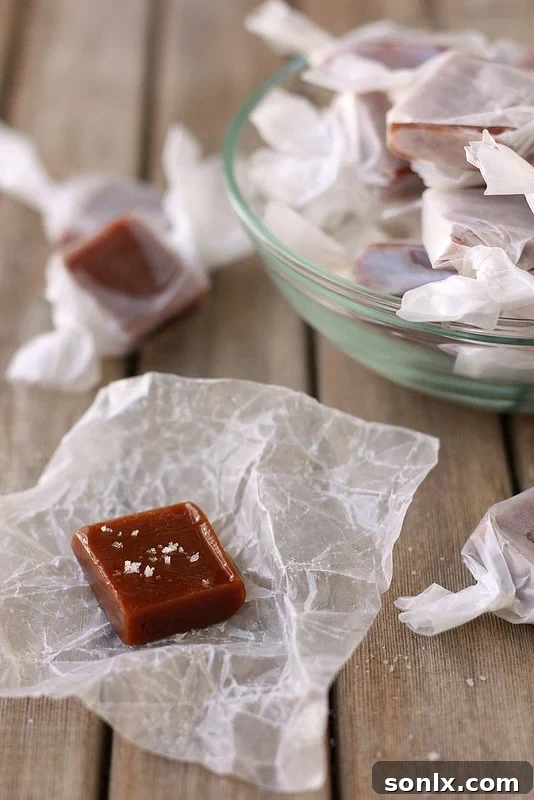
There’s an undeniable magic to homemade treats, and few confections capture hearts quite like **chewy homemade caramels with a delightful hint of sea salt**. Imagine sinking your teeth into a rich, buttery, melt-in-your-mouth piece of candy, perfectly balanced by a delicate sprinkle of crystalline sea salt. This isn’t just a dessert; it’s an experience, a journey into the simple pleasures of artisanal confectionery that promises to tantalize your taste buds and impress anyone lucky enough to share them.
For too long, the idea of crafting caramels from scratch seemed daunting, a culinary feat reserved for seasoned confectioners with specialized kitchens. But I’m here to tell you that this widespread misconception is just that—a myth. The internet is awash with countless variations of homemade caramel recipes, each looking more irresistible than the last, and for good reason: they are surprisingly straightforward to create! Many home bakers, including myself, have found immense joy and satisfaction in discovering just how accessible and rewarding this process can be. It’s time to shed any intimidation and embrace the simple elegance of homemade candy.
Unlocking the Secret to Perfect Homemade Caramels: Simplicity and Focus
The beauty of homemade caramels lies in their fundamental simplicity. You don’t need an arsenal of gourmet equipment or esoteric, hard-to-find ingredients. At its core, all you truly need are a few basic pantry staples – sugar, cream, butter, and corn syrup – a reliable candy thermometer, a sturdy stovetop, and, perhaps most importantly, a dash of courage. That courage comes from shedding any preconceived notions about candy making being overly complicated or fraught with potential failures. It’s a process that rewards patience and attention, not necessarily advanced culinary degrees.
Many aspiring confectioners are initially intimidated by the precision required in candy making, especially when terms like “candy thermometer” and “boiling sugar” enter the conversation. While these elements are undeniably crucial to achieving the perfect consistency, they shouldn’t be sources of fear. In reality, mastering the art of caramelization is well within the grasp of any home cook willing to pay a little attention and follow instructions diligently. Think of it less as a high-stakes chemistry experiment and more as a mindful cooking process, where your presence and unwavering focus are your most valuable tools. Once you demystify the process, you’ll find an incredible sense of accomplishment and a lifetime supply of delicious homemade treats.
Essential Tips for Caramel-Making Success: A Focused Approach
The single most important piece of advice for candy making, particularly when working with caramel, is this: **do not multitask**. This is not the moment to check your email, scroll through social media, or apply makeup. Caramelization happens quickly, and precise timing is everything. A few seconds of inattention can mean the difference between perfectly golden, soft, chewy caramel and a burnt, bitter, and ultimately wasted batch. Your stovetop handles the heavy lifting of heating and transforming the sugar; your essential role is to supervise with unwavering focus and intervene at precisely the right moment.
Keep a vigilant eye on your candy thermometer and the evolving color of your sugar mixture. The transformation from clear syrup to a rich, amber caramel is a beautiful, albeit rapid, dance of chemistry. As the sugar heats, it undergoes a complex series of reactions, developing its characteristic flavor and hue. This process requires your constant presence. When your caramel reaches precisely the instructed temperature—typically around 248°F (120°C) for a chewy caramel—promptly remove it from the heat. This exact timing ensures you’ll achieve that quintessential chewy, rich, and utterly irresistible texture that makes homemade caramels so addictive. Trust me on this—my last batch disappeared almost instantly, a testament to their unparalleled deliciousness and the importance of following these critical steps!
The Allure of Sweet and Salty: Why Sea Salt Caramels Reign Supreme
The addition of sea salt isn’t just a garnish; it’s a profound enhancement, elevating these caramels from merely delicious to truly extraordinary. The interplay between the deep, sweet, and complex notes of the caramel and the subtle, briny crunch of the salt creates a flavor profile that is both complex and incredibly satisfying. It’s that classic “sweet and salty” marriage, perfected in candy form, that makes these treats so profoundly addictive. The salt performs a dual role: it cuts through the richness of the butter and sugar, preventing the caramel from being cloyingly sweet, and instead highlights its nuanced flavors, creating a more sophisticated and balanced taste experience.
While I often reach for “fleur de sel” – a delicate, expensive, and flaky sea salt that I reserve for special culinary moments due to its unique texture and mineral complexity – any good quality coarse sea salt will perform beautifully. Fleur de sel, with its pyramid-shaped crystals, dissolves gently on the tongue, leaving tantalizing pockets of intense saltiness that burst on the palate, creating a truly gourmet experience. However, don’t feel limited if you don’t have it. A high-quality coarse ground sea salt, such as Maldon or even a good kosher salt, will provide a fantastic textural contrast and flavor boost. The key is to use a salt that hasn’t been overly processed, allowing its natural character and clean flavor to shine through. This thoughtful addition of salt is what makes these homemade sea salt caramels exceptionally moreish, so be warned: a single piece might quickly turn into two, then three, and before you know it, the entire batch is delightfully devoured!
Baking Tip: How to Achieve the Perfect Caramel “Swirl” (and Why You Don’t Stir!)
Many caramel recipes, including this one, adamantly advise you to “swirl” the pan instead of stirring the sugar mixture once it begins to caramelize. This instruction is crucial for achieving a smooth, professional-grade caramel. Initially, you will combine and stir your sugar, corn syrup, and water together until the sugar fully dissolves. But once the mixture comes to a boil and you stop stirring, put down that whisk and resist the urge to stir it again throughout the caramelization process!
The reason behind this “no-stirring” rule is to prevent sugar crystallization. Stirring crystallized sugar can inadvertently introduce undissolved sugar crystals from the sides of the pan back into the super-saturated sugar solution. These tiny crystals then act as seeds, causing the entire batch to crystallize and become grainy rather than smooth and chewy. Instead, as you diligently watch the sugar cook and its color deepens, if you notice certain areas of the pan browning more rapidly than others, simply lift the pan by its handle. Use a gentle wrist motion to carefully swirl the contents around. This technique allows the caramel to cook evenly and prevents localized burning, ensuring a beautifully consistent texture and a rich, golden color throughout your entire batch of irresistible homemade caramels.
The Ultimate Sea Salt Caramels Recipe: Craft Your Own Sweet & Salty Indulgence
Ready to embark on your own caramel-making adventure? This recipe provides precise instructions to guide you through each step, ensuring a successful and incredibly delicious outcome. Gather your ingredients, prepare your workspace, and get ready to create the most divine homemade sea salt caramels you’ve ever tasted. The satisfaction of making these treats from scratch is immense, and the reward is truly unmatched.
Sea Salt Caramels
64 caramels
5 mins
15 mins
2 hrs
2 hrs 20 mins
Pin Recipe
Leave a Review
Ingredients
- 1 cup heavy cream (236 ml)
- 5 tablespoons unsalted butter (70 grams)
- 1 teaspoon fleur de sel or other coarse sea salt, plus extra for sprinkling
- 1 ½ cup granulated sugar (300 grams)
- ¼ cup light corn syrup (60 ml)
- ¼ cup water (60 ml)
- ½ teaspoon vanilla extract
Instructions
- Line an 8-inch square baking pan with parchment paper, allowing some overhang on the sides for easy removal.
- In a small saucepan, combine the heavy cream, unsalted butter, and the 1 teaspoon of sea salt. Bring this mixture to just a boil over medium heat, then reduce heat to low to keep it warm. Do not let it boil vigorously or reduce.
- Meanwhile, in a separate, larger heavy-bottomed saucepan, combine the granulated sugar, light corn syrup, and water. Stir gently over medium heat until all the sugar has completely dissolved and the mixture is clear.
- Once the sugar is dissolved, stop stirring. Increase the heat to medium-high and allow the mixture to simmer without stirring. Watch it closely as it begins to bubble and transform, turning from clear to a pale amber, then a rich golden-amber color. If you notice certain areas browning faster than others, gently swirl the pan by the handle to ensure even caramelization. This no-stirring technique is crucial to prevent sugar crystallization.
- When the sugar mixture reaches a beautiful deep amber color, remove it from the heat immediately. Carefully and slowly pour the warm cream mixture into the hot caramel while whisking constantly. Be extremely cautious as the mixture will bubble violently and emit hot steam. Once combined and the bubbling subsides, stir in the vanilla extract.
- Return the saucepan to medium-low heat and immediately insert your candy thermometer. Continue to cook, without stirring, until the thermometer registers exactly 248°F (120°C). This temperature is essential for achieving the perfect chewy texture.
- As soon as the caramel reaches 248°F (120°C), remove the pan from the heat. Immediately pour the hot caramel mixture into your prepared 8-inch square baking pan.
- Allow the caramel to cool undisturbed at room temperature for at least 2 hours, or until it is completely firm. Once firm, sprinkle additional coarse sea salt over the top, if desired. Using a sharp, greased knife, cut the caramel into 1-inch squares.
- To store, wrap each individual caramel square in 4-inch wax paper squares, twisting the ends to seal. Store the wrapped caramels at room temperature in an airtight container for up to 2 weeks. Enjoy your homemade sea salt caramels!
Notes
Salt Selection: Fleur de sel, prized for its delicate flakes and subtle flavor, can be found at specialty grocery stores or online. However, any good quality coarse sea salt (like Maldon or a coarse Himalayan pink salt) can be substituted for excellent results, providing a wonderful textural contrast and balancing flavor.
Temperature Control: A reliable candy thermometer is your best friend for this recipe. Ensure it’s calibrated and accurately registers the temperature for optimal caramel consistency. Undercooking will result in a softer, looser caramel, while overcooking will yield a harder, more brittle one.
Nutrition Information (per caramel)
- Calories: 43 kcal
- Carbohydrates: 6g
- Protein: 1g
- Fat: 2g
- Saturated Fat: 1g
- Cholesterol: 7mg
- Sodium: 2mg
- Potassium: 3mg
- Sugar: 6g
- Vitamin A: 82 IU
- Vitamin C: 1mg
- Calcium: 3mg
Tried this incredible recipe? I’d be absolutely thrilled to hear about your experience! Please consider leaving a rating and review below, sharing your thoughts and triumphs with these delectable caramels. Your feedback truly helps our community grow and inspires others to get cooking!
Or, if you’re proud of your homemade creation, snap a photo and tag it on Instagram @completelydelicious using the hashtag #completelydelicious. We love seeing your culinary masterpieces!