Mastering Homemade Focaccia: An Easy Recipe for Rosemary Parmesan Perfection
For years, the thought of baking bread from scratch filled me with a peculiar mix of awe and dread. The precise measurements, the delicate yeast, the elusive perfect rise – it all seemed like a culinary Everest. But I’m thrilled to announce that I’ve finally conquered that fear! While I might not be a grand master of the boulangerie just yet, I can confidently say that the mystery of bread baking has unravelled for me. This newfound confidence has opened up a world of delightful possibilities, and today, we’re celebrating with a truly spectacular creation: a fantastic Rosemary and Parmesan Focaccia.
Baking this focaccia yesterday wasn’t just a triumph; it was a pure joy. The aroma alone filled my kitchen with an irresistible warmth, hinting at the deliciousness to come. The result? A bread that’s not only incredibly satisfying to bake but even more so to eat. I’m convinced that once you try this easy focaccia recipe, you’ll share my enthusiasm and perhaps even find your own bread-baking fears melting away, replaced by the simple pleasure of crafting something wonderful with your own hands. Get ready to impress yourself and your loved ones with this artisan-quality homemade focaccia!
The Irresistible Charm of Rosemary Parmesan Focaccia
Let’s be honest, few things in life are as comforting and satisfying as a truly exceptional piece of bread. And for those of us who unabashedly adore carbohydrates, focaccia holds a special place. If my waistline were entirely forgiving, I’d happily indulge in a generous slice of this bread with every single meal. It’s not just food; it’s an experience, a simple pleasure that elevates any dining occasion.
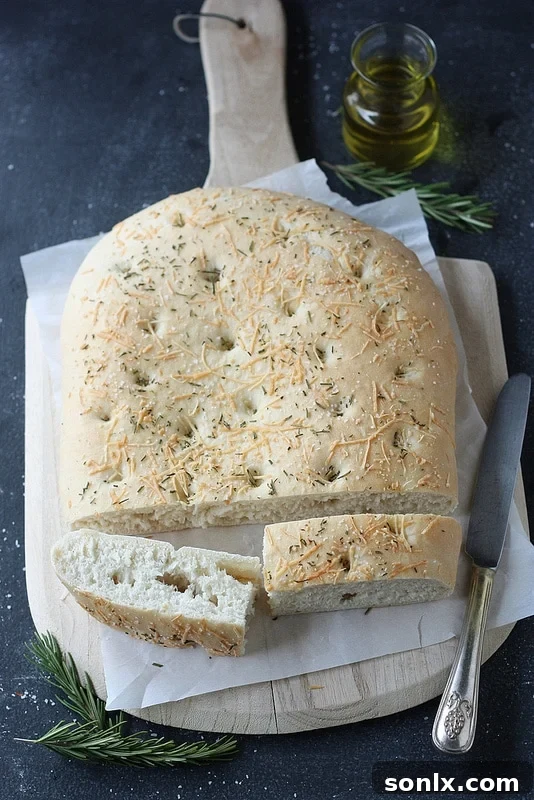
What makes this Rosemary Parmesan Focaccia stand out? It’s a symphony of textures and flavors that dance on your palate. The exterior boasts a delightful crispness, a golden crust that crackles ever so slightly with each bite, hinting at the care that went into its creation. Inside, it reveals a tender, airy, and wonderfully chewy crumb, a perfect contrast to its outer shell. This unique combination ensures every mouthful is a delightful journey.
But the true magic lies in its topping. Fragrant fresh rosemary, a herb renowned for its earthy and slightly piney notes, is finely chopped and scattered generously. This is complemented by savory grated Parmesan cheese, which melts into pockets of salty, nutty goodness, creating bursts of flavor. A final, crucial touch is a sprinkling of coarse sea salt, which provides both texture and an enhanced savory profile that deepens the overall taste. These ingredients meld together during baking to infuse every inch of the bread with an exquisite, aromatic flavor. This isn’t a bread that needs butter or jam; it’s a masterpiece designed to be savored entirely on its own, a testament to simple, high-quality ingredients.
Beyond its inherent deliciousness, focaccia is incredibly versatile. While perfect as a standalone snack or a sophisticated appetizer, it also makes an excellent accompaniment to a wide array of dishes. Imagine tearing off a warm piece and dipping it into a rich olive oil and balsamic vinegar blend – pure bliss! It pairs beautifully with hearty soups, robust stews, crisp salads, or your favorite pasta dishes, absorbing all the wonderful flavors. Moreover, focaccia serves as a phenomenal base for unique gourmet sandwiches, transforming an ordinary lunch into an extraordinary culinary event. Don’t hesitate to experiment with the toppings; the beauty of focaccia is its adaptability. Consider sun-dried tomatoes, black olives, caramelized onions, different herbs like thyme or oregano, or even other cheeses like feta or Gruyère. The possibilities are genuinely endless, allowing you to tailor each batch of homemade focaccia to your mood or the contents of your pantry, ensuring you’ll never get bored.
Conquering Culinary Challenges: What’s Your Next Baking Adventure?
Now that I’ve (mostly) demystified the art of bread baking, my mind is already wandering to the next culinary frontier. What baking fear should I set my sights on next? Perhaps the delicate layers of croissants, which require an intricate dance of butter and dough, or the flaky intricacy of puff pastry, a cornerstone of so many exquisite desserts and savory treats? Both seem daunting, yet exhilarating, promising rewarding challenges and delicious outcomes. I’d love to hear from you – what scares you most in the kitchen? What baking challenge have you always wanted to tackle but haven’t quite dared to?
Essential Baking Tip: The “Window Pane” Test for Perfectly Kneaded Dough
Achieving the right dough consistency is paramount for successful bread baking, and kneading plays a crucial role in developing the gluten structure that gives bread its characteristic texture and rise. Whether you’re kneading your dough by hand, a wonderfully tactile experience that connects you directly to your food, or with the efficiency of a powerful stand mixer, the exact kneading time will naturally vary. Factors such as the type of bread you’re making, the speed of your mixer, the hydration level of your dough, the protein content of your flour, and even the ambient room temperature can influence how long it takes to develop the gluten properly.
Instead of rigidly relying on a timer, which can often be misleading and lead to either under- or over-kneaded dough, it’s far more effective to understand the visual and tactile cues of a properly kneaded dough. When adequately developed, your dough should undergo a noticeable transformation: it will appear smooth and uniform on the outside, losing its shaggy, sticky, and uneven quality. More importantly, it should feel incredibly elastic, resilient, and springy to the touch. This elasticity is what gives bread its robust structure, its desirable chewiness, and its ability to hold the gases produced by the yeast, resulting in a light and airy crumb.
The definitive method for testing this elasticity and ensuring optimal gluten development is known as the “window pane” test. This simple yet ingenious technique allows you to visibly check the integrity of your gluten network. To perform this test:
- Step 1: Pinch off a small piece of dough. Take a small, golf-ball-sized portion of dough from your main mass.
- Step 2: Gently stretch the dough. Hold this piece between your fingers, typically your thumbs and forefingers, and slowly and carefully begin to stretch it. Observe carefully what happens as you pull.
- What to look for:
- Under-kneaded Dough: If the dough has not been sufficiently kneaded, it will feel very sticky and will likely tear apart almost immediately as you try to stretch it. This indicates that the gluten strands haven’t fully formed and strengthened yet. If this happens, return the dough to your mixer or continue kneading by hand for a few more minutes, then test again.
- Properly Kneaded Dough: Dough that has been sufficiently kneaded will stretch easily without tearing. As you pull it gently, it will become very thin and translucent, almost like a delicate membrane. You should be able to see light passing through it, much like looking through a window pane, without the dough breaking. This signifies that the gluten network is robust and well-developed, ready to trap the gases produced by the yeast and create that wonderful airy texture we crave in bread.
Mastering this simple test will significantly elevate your bread baking skills, ensuring consistent results and beautifully structured loaves every time. It’s a foundational skill for any aspiring baker who wants to create truly exceptional bread.
Rosemary and Parmesan Focaccia Recipe
8
servings
20
mins
25
mins
1
hr
15
mins
2
hrs
Delight in the simple elegance of homemade Rosemary and Parmesan Focaccia. This recipe yields a light, airy, and incredibly chewy bread with a perfectly crusty exterior, generously topped with aromatic fresh rosemary, sharp Parmesan cheese, and a finishing sprinkle of coarse sea salt. Ideal as a flavorful side dish for any Italian meal, a sophisticated appetizer, or even as the foundation for gourmet sandwiches. Its robust flavor and satisfying texture make it a versatile staple that’s surprisingly easy to master.
Pin Recipe
Leave a Review
Ingredients
- 1 cup water (237 ml), warmed to 120-130°F (49-54°C)
- 1 tablespoon olive oil (for dough)
- 2-3 cups bread flour (240-360 grams), plus more for dusting
- 1 teaspoon salt (fine grain)
- 1 tablespoon granulated sugar
- 2 ¼ teaspoons active dry yeast (1 package, 7 grams)
- 1 tablespoon fresh rosemary (finely chopped)
- ¼ cup grated parmesan cheese (25 grams)
- Additional olive oil, for brushing and pan greasing
- Coarse sea salt, for sprinkling
Instructions
-
Combine water and 1 tablespoon of olive oil in a small saucepan. Heat over medium heat until it just begins to simmer, around 120-130°F (49-54°C). This temperature is crucial for activating the yeast without killing it. Remove from heat and allow to cool for approximately 5 minutes, ensuring the temperature is within the optimal range for yeast activation.
-
In the bowl of a stand mixer equipped with a dough hook attachment, combine 1 cup of the bread flour with the fine grain salt, granulated sugar, and active dry yeast. Pour in the warmed water and olive oil mixture. Mix on low speed until a wet, shaggy dough forms. Stop the mixer occasionally to scrape down the sides of the bowl, ensuring all ingredients are fully incorporated.
-
Gradually add the remaining bread flour, ¼ cup at a time, continuing to mix until the dough pulls away cleanly from the sides of the bowl. The dough should feel tacky to the touch but should no longer stick to your fingers. Increase the mixer speed to medium-low and knead for 5-7 minutes. The dough is ready when it is smooth, elastic, and passes the “window pane” test (as described in our baking tip above). Transfer the kneaded dough to a lightly greased bowl, turning it once to ensure the entire surface is coated. Cover the bowl with plastic wrap or a clean kitchen towel and let it rise in a warm, draft-free place until it has doubled in size, which typically takes about 1 hour.
-
Once doubled, gently punch down the dough to release the accumulated gases. Briefly knead it a few times on a lightly floured surface to remove any remaining large air bubbles. Lightly grease a large baking sheet (approximately 10×14 inches) with olive oil. Shape the dough into a rough 14-inch circle or rectangle on the prepared baking sheet. Cover it again and allow it to rest for an additional 15 minutes, which helps relax the gluten. After this brief rest, use your fingertips to create deep dimples all over the surface of the dough, pressing firmly all the way down to the pan. Drizzle generously with additional olive oil, then evenly sprinkle with the chopped fresh rosemary, grated Parmesan cheese, and coarse sea salt.
-
Preheat your oven to 375°F (190°C). Bake the focaccia on the center rack for 20-25 minutes, or until the crust is beautifully golden brown and the edges are crisp. Keep an eye on it to prevent over-browning.
-
Once baked, remove the focaccia from the oven and transfer it to a wire rack to cool slightly. Focaccia is absolutely best when served warm, straight from the oven, to fully appreciate its fresh flavors and textures. However, if you have leftovers, they will keep well wrapped tightly in foil or plastic wrap at room temperature for a few days. For best results, gently reheat before serving.
Notes
Recipe adapted from Red Star Yeast.
Nutrition Information
Carbohydrates: 26g,
Protein: 6g,
Fat: 3g,
Saturated Fat: 1g,
Cholesterol: 3mg,
Sodium: 342mg,
Potassium: 63mg,
Fiber: 2g,
Sugar: 2g,
Vitamin A: 34IU,
Calcium: 39mg,
Iron: 1mg
Italian
Side Dish, Appetizer
Annalise Sandberg
Have you baked this delicious Rosemary Parmesan Focaccia?
We’d be thrilled to hear about your experience! Please take a moment to leave a rating and review below. Or, if you’ve captured a photo of your culinary masterpiece, tag us on Instagram @completelydelicious using the hashtag #completelydelicious. Your feedback inspires us!
Disclaimer: This post is sponsored by Red Star Yeast. All opinions are my own.