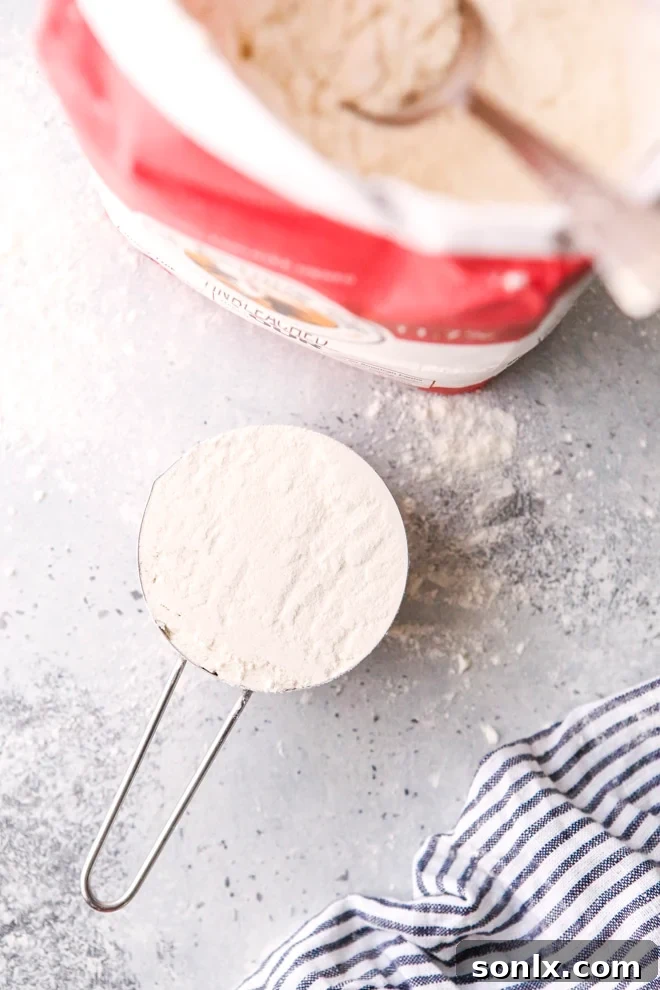
Achieve unparalleled baking success by learning the essential “spoon and sweep” method for measuring flour. Say goodbye to wasted time and ingredients, and instead, welcome consistently perfect baked goods into your life.
The timeless adage, “Baking is a science,” holds profound truth. Every ingredient plays a crucial role, and the proportions are fundamental to the final outcome. Even a slight deviation in ingredient amounts can dramatically alter the texture, taste, and appearance of your culinary creations. Among all ingredients, how you measure flour is arguably one of the most critical factors that will dictate the success or failure of your recipe.
One of the most common pitfalls home bakers encounter is incorrect flour measurement. This seemingly minor mistake often leads to adding an excessive amount of flour to recipes, resulting in baked goods that are disappointingly dry, dense, crumbly, or tough. Fortunately, this is an incredibly easy fix! Once you master the correct technique, this simple error will become a distant memory, paving the way for consistently delightful baking results.
Table of Contents
- The Absolute Importance of Accurate Flour Measurement
- The Common Mistake to Avoid When Measuring Flour
- Mastering the “Spoon and Sweep” Method for Flour
- The Gold Standard: Using a Digital Scale for Precision
- Understanding Flour Types and Density
- Navigating Flour Measurement Discrepancies
- Beyond Flour: Accurate Measurement for All Dry Ingredients
- Your Journey to Baking Excellence Starts Now!
- More Essential Baking Tips and Guides
The Absolute Importance of Accurate Flour Measurement
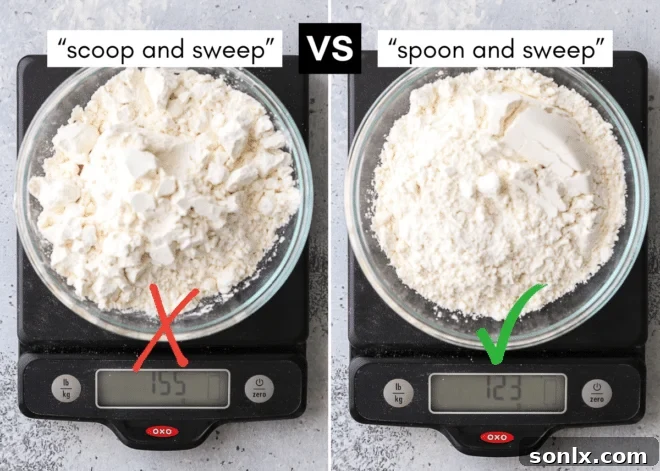
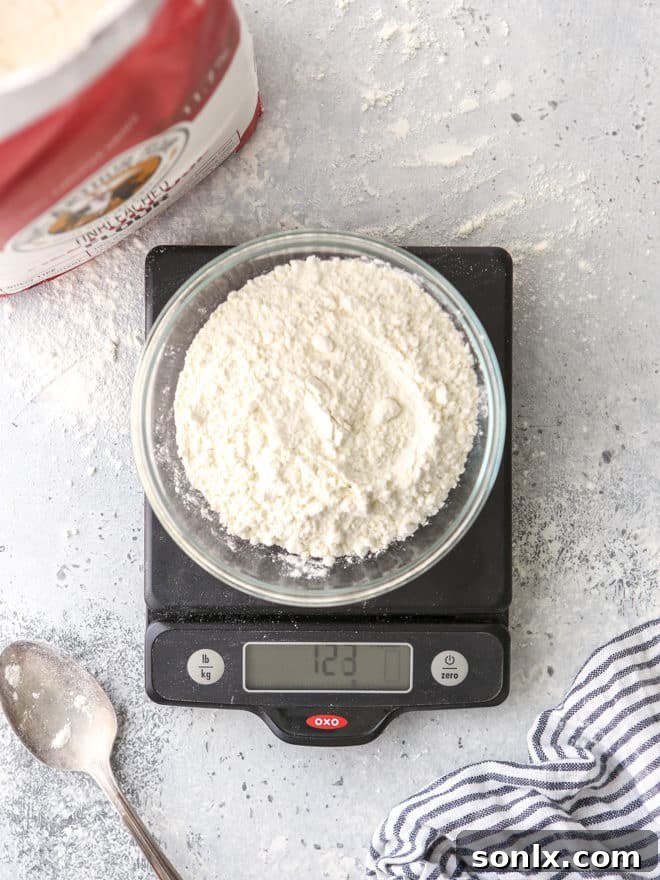
Does the method of measuring flour truly make a difference? A resounding, unqualified yes, it absolutely matters! To illustrate this crucial point, consider the visual evidence below. Both images depict what appears to be one cup of flour, yet the profound difference lies solely in the measurement technique employed. Observe the significant variation in weight! An excess of just 30 grams of flour—which can easily occur with improper technique—can lead to drastically different results in nearly any baked good you prepare.
Imagine this scenario: cookies intended to be chewy and perfectly spread might turn out cakey and stubbornly retain their original shape. Cakes designed to be moist and tender could become unpleasantly dry and dense. Breads, meant to be light and airy, might end up tough and heavy. These outcomes are not simply minor imperfections; they are direct consequences of inaccurate flour measurement, underscoring why precision is paramount in baking.
The Common Mistake to Avoid When Measuring Flour
Referencing the image above, the flour on the left was measured using a technique we strongly advise against. This method involves directly dipping the measuring cup into the flour canister or bag, scooping it out, and then leveling off the top. As demonstrated, this particular cup of flour weighed in at a hefty 155 grams, which translates to almost an additional third of a cup of flour beyond what most recipes intend for a standard cup measurement!
Why this method doesn’t work: The fundamental flaw in this direct scooping approach lies in the inherent nature of flour. Flour, particularly when left undisturbed in its container, naturally settles and compacts over time due to gravity and vibrations. As these fine particles settle, they pack together, creating a denser mass. When you plunge a measuring cup directly into this compacted flour, you inevitably force more flour into the cup than intended. This results in a measurement that is significantly heavier and contains more flour by weight than a properly aerated, lighter cup. This excess flour is the culprit behind many baking disappointments, leading to the dry, dense, or tough textures no baker desires.
Mastering the “Spoon and Sweep” Method for Flour
Also widely known as the “spoon and level” method, this technique is your secret weapon for consistently accurate flour measurements. Whether you call it “spoon and sweep” or “spoon and level,” the process and the perfect results it yields are precisely the same. Follow these simple steps to ensure your flour is measured with precision every single time:
-
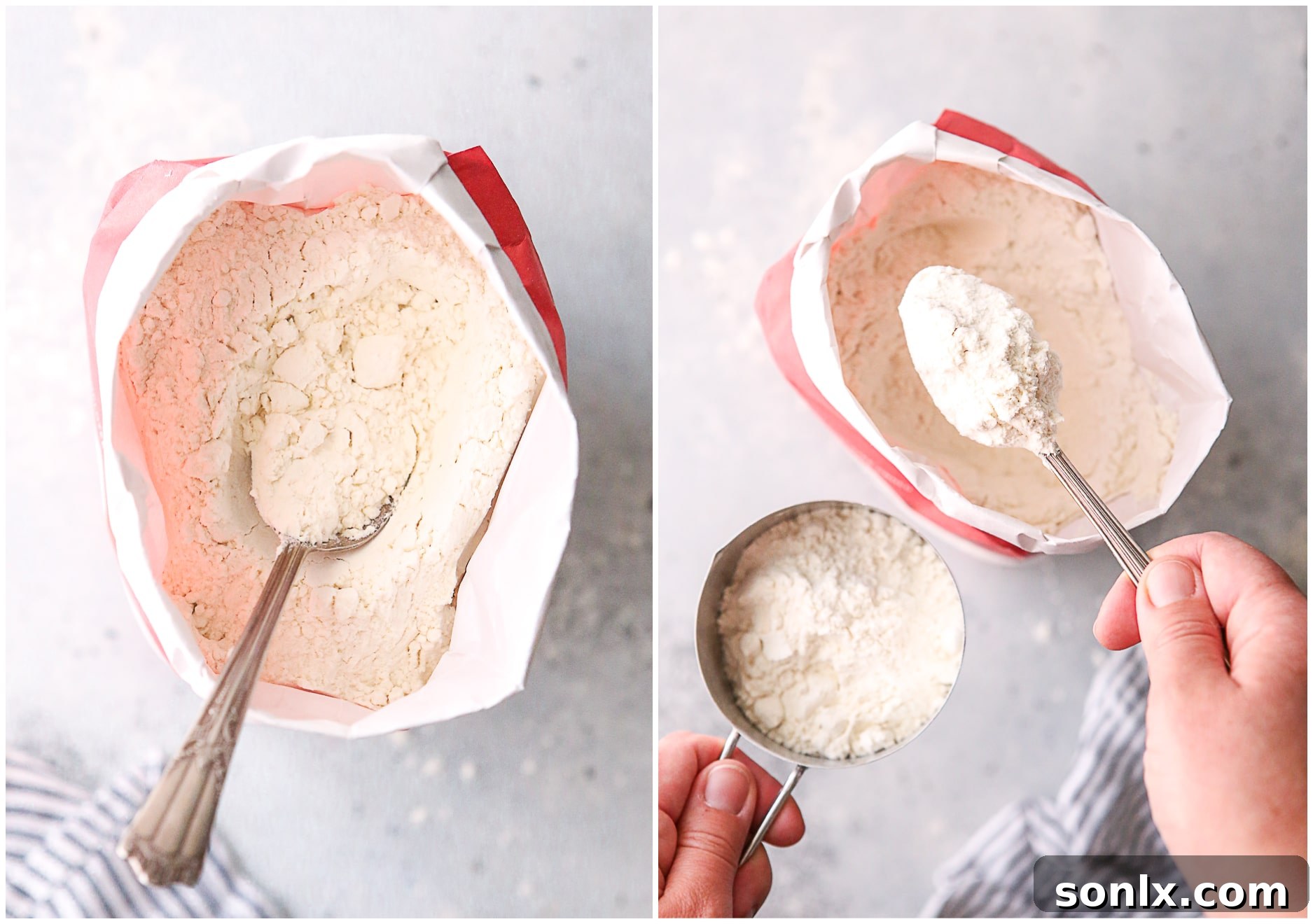
Fluff the Flour: Before you even begin measuring, it’s crucial to aerate your flour. Use a spoon, a whisk, or even the measuring cup itself to gently fluff and loosen the flour within its container or package. This step is vital because it reintroduces air into the compacted flour, returning it to a lighter, more accurate state. I typically give it 4-5 good, thorough “fluffs” to ensure it’s well aerated.

Fluffing the flour helps to de-compact it and incorporate air. - Spoon Flour into Measuring Cup: Once your flour is sufficiently fluffed, use a separate spoon (or even a smaller scoop) to gently spoon the flour into your dry measuring cup. Do not pack the flour down. The goal is to let it fall lightly into the cup, maintaining the airiness you just created.
-
Fill Until Measuring Cup is Overflowing: Continue spooning the flour into the measuring cup until it is well mounded over the rim. It should look like a small hill of flour, demonstrating that you haven’t compressed it.
Ensure the flour is mounded over the rim before sweeping. - Sweep the Top: Finally, take a flat edge, such as the back of a butter knife, an offset spatula, or even a straight-edged ruler, and gently sweep it across the top of the measuring cup. This action will level off the excess flour, allowing it to fall back into your flour container or bag. The result is a perfectly level cup of flour that has not been compacted.
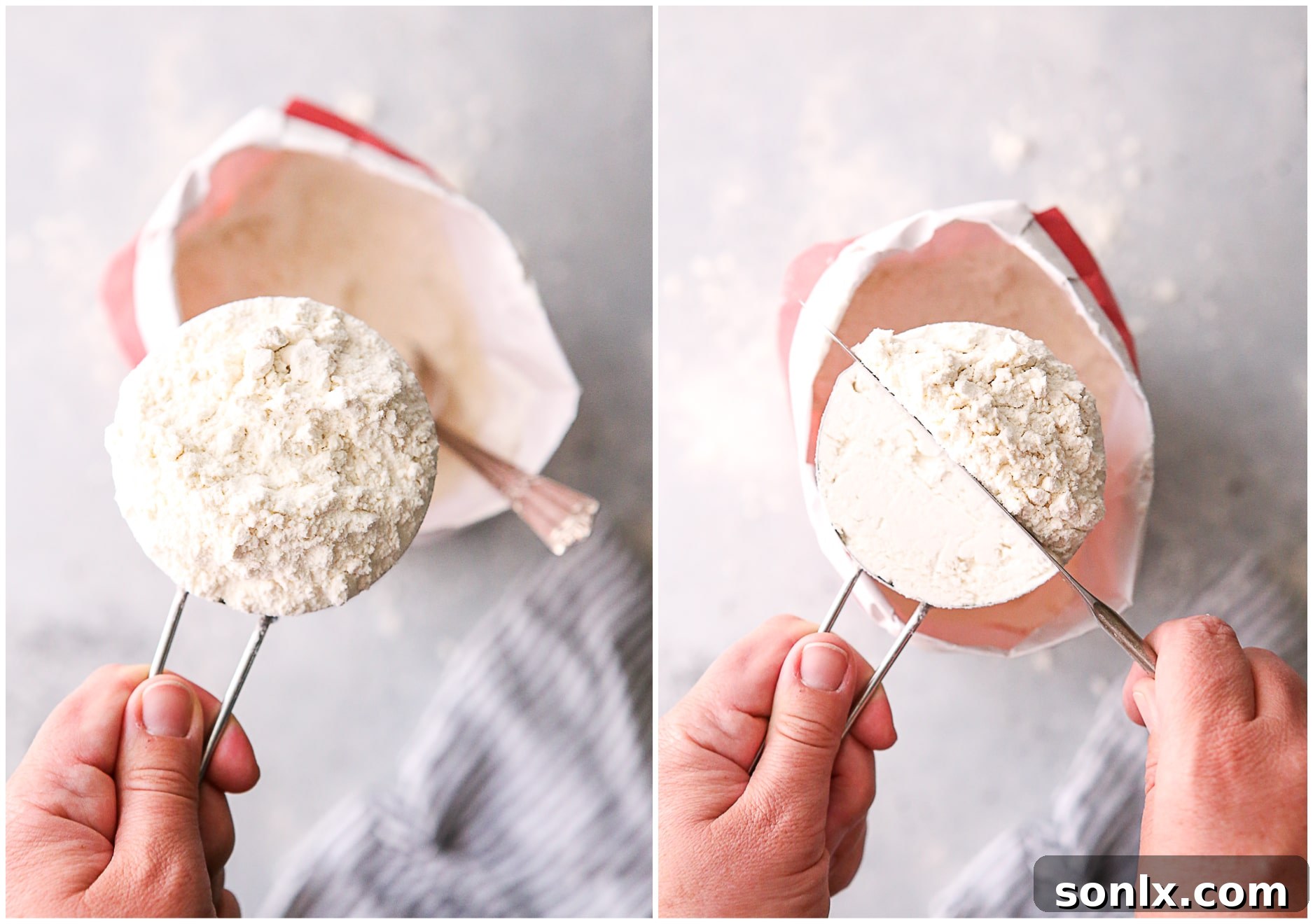
Why this method works: The beauty of the “spoon and sweep” method lies in its ability to counteract flour compaction. Regardless of how long your flour has been sitting in its container, the initial fluffing step reintroduces essential air, bringing it closer to its original, lighter density. By then gently spooning it into the measuring cup, you prevent re-compaction. The final sweeping action ensures that you’re removing only the excess, leaving you with a consistent, accurate volume measurement every single time. This consistency is the cornerstone of successful baking, as it ensures your recipes turn out as intended, irrespective of how long the flour has been stored.
Note: This reliable method of measuring flour is universally applicable for almost all varieties of wheat flour commonly used in baking. Whether your recipe calls for all-purpose flour, bread flour, cake flour, pastry flour, or self-rising flour, the “spoon and sweep” technique will provide the accurate volume measurement needed for optimal results.
The Gold Standard: Using a Digital Scale for Precision
Are you looking for the simplest and most effective way to elevate your baking skills and achieve truly consistent, professional-level results? The answer lies in incorporating a digital kitchen scale into your baking arsenal. Without a doubt, the single most accurate method for measuring ingredients, especially flour and other dry components, is by weight in grams, rather than relying on volume measurements provided by traditional measuring cups. This is why professional bakers and pastry chefs worldwide almost exclusively use scales.
Measuring by weight eliminates all the guesswork and variability associated with volume measurements. Factors like how tightly flour is packed, humidity levels, or even the specific design of a measuring cup become irrelevant when you measure by grams. A gram is a gram, universally consistent, ensuring that your recipe will turn out the same way every time you make it, regardless of external conditions. This level of precision is truly transformative for baking, guaranteeing that your doughs, batters, and mixtures have the exact consistency intended by the recipe developer. If a recipe provides weight measurements, always opt for the scale over cups.
Investing in a good digital scale is a small step that yields monumental improvements in your baking journey. It’s incredibly easy to use: simply place your mixing bowl on the scale, hit the “tare” button to zero it out, and add your ingredient until you reach the specified weight. No more levelling, no more questioning if your flour is too packed or too loose.
Dive deeper into the fascinating world of baking accuracy and understand the critical differences between weight vs. volume measurements here! You’ll find a wealth of insightful, “nerdy” baking information that will empower you to become a more precise and confident baker.
Understanding Flour Types and Density
While the “spoon and sweep” method is effective for all wheat flours, it’s worth noting that different types of flour naturally possess varying densities. For example, cake flour is typically finer and lighter than all-purpose flour, which in turn is generally less dense than bread flour. These subtle differences mean that a “cup” of cake flour will weigh slightly less than a “cup” of all-purpose flour, even when measured correctly using the “spoon and sweep” method. This inherent variability further emphasizes why measuring by weight with a digital scale is the ultimate path to consistency, as it completely bypasses these density differences.
Navigating Flour Measurement Discrepancies
It’s important for home bakers to be aware that a slight discrepancy often exists regarding the standard weight of “1 cup of flour” across various recipe developers and culinary publications. For instance, King Arthur Baking, a highly reputable baking source I deeply trust and have often used as a guide, states that 1 cup of all-purpose flour equals 120 grams. However, through extensive testing in my own kitchen, I’ve found that consistently achieving exactly 120 grams using the “spoon and level” method can be quite challenging, as evidenced in the accompanying photos which show measurements closer to 125-130 grams.
Therefore, for all recipes published on this website, my established standard for 1 cup of all-purpose flour is now between 125-130 grams. I am in the process of gradually updating my existing recipes to reflect this precise weight amount. Until then, you can always rest assured that every recipe on this site has been meticulously tested and perfected using the precise “spoon and level” method described above. When in doubt, always defer to the recipe creator’s specified measurement (whether volume or weight), as their recipes are developed and tested using their particular standard.
Beyond Flour: Accurate Measurement for All Dry Ingredients
The principles of accurate measurement, particularly the “spoon and sweep” method and the benefits of a digital scale, extend beyond just flour. Dry ingredients such as cocoa powder, powdered sugar (confectioners’ sugar), granulated sugar (though less prone to compaction), oats, and even leavening agents like baking soda and baking powder, all benefit from careful measurement. While compacted brown sugar is intentionally packed, most other dry ingredients should be measured lightly. Adopting these precise techniques for all your dry ingredients will contribute significantly to the overall consistency and success of all your baking endeavors.
Your Journey to Baking Excellence Starts Now!
With this newfound knowledge, you are now equipped to measure flour with the precision of a seasoned professional. You understand not only the correct technique but also the critical mistakes to avoid. This fundamental skill is your gateway to unlocking a whole new level of baking success. The next time you step into the kitchen, consciously remember to “spoon and sweep” (or better yet, use your digital scale!) and truly observe the remarkable difference it makes in the texture and quality of your delicious creations.
More Essential Baking Tips and Guides
Enhance your baking repertoire with these additional expert tips and detailed guides:
- How to Build a Layered Cake: Master the art of creating stunning, stable tiered cakes.
- Use Parchment Paper to Make Baking Easier: Discover the many benefits of this simple kitchen essential.
- Do Eggs Really Need to Be at Room Temperature?: Uncover the science behind ingredient temperature and its impact on your recipes.
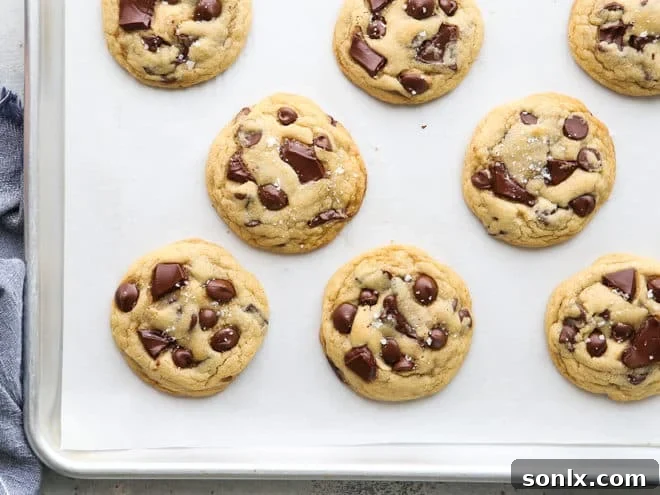
- How to Bake Picture Perfect Cookies: Learn the tricks for achieving professional-looking, delicious cookies every time.
How to Measure Flour Correctly
Learn how to measure flour using the “spoon and sweep” method for the most consistent and successful results in all your baking endeavors!
Equipment
Instructions
-
Begin by fluffing the flour. Use a spoon or a measuring cup to thoroughly loosen and aerate the flour inside its container or bag. A good 4-5 vigorous “fluffs” will help de-compact it.
-
Gently spoon the fluffed flour into your dry measuring cup, one spoonful at a time. Continue this process until the flour is generously mounded over the rim of the cup.
-
Using a flat edge, such as the back of a knife or a straight spatula, sweep across the top of the measuring cup to level the flour. Allow any excess flour to fall back into your flour container.
-
A properly measured cup of all-purpose flour using this method should ideally weigh between 125-130 grams. For the utmost accuracy and consistent measurements, always opt for a digital kitchen scale!
I’d love to hear about it! Leave a rating and review below, or take a photo and tag it on Instagram @completelydelicious with #completelydelicious.