The Allure and Challenge of French Macarons: A Daring Bakers Journey
Welcome to a culinary adventure that tested my patience and skills! The October 2009 Daring Bakers’ challenge, masterfully presented by Ami S., brought a truly iconic dessert to the forefront: French macarons. This intricate recipe, sourced from Claudia Fleming’s esteemed cookbook, “The Last Course: The Desserts of Gramercy Tavern,” was not just a baking task but a profound lesson in precision, perseverance, and passion. It promised both frustration and immense reward, and it certainly delivered on both fronts, transforming a daunting task into a sweet triumph.
Embarking on the Daring Bakers October 2009 Challenge
The Daring Bakers community is renowned for pushing culinary boundaries and encouraging home bakers to tackle challenging recipes. Each month, a selected recipe, often from a celebrated pastry chef or cookbook, becomes the focal point, uniting a global network of enthusiastic bakers. The October 2009 assignment, French macarons, was particularly exciting and, as I soon discovered, notoriously demanding. Ami S.’s choice of Claudia Fleming’s recipe from “The Last Course” immediately signaled the seriousness of the challenge. Fleming’s reputation for elegant, meticulously crafted desserts meant this was no ordinary cookie; it was an exercise in the art of patisserie.
My journey into the world of French macarons began amidst a rather chaotic October. Life, as it often does, threw several curveballs: I was unexpectedly unwell on two separate occasions, and a much-anticipated week-long vacation further compressed my schedule. Finding an uninterrupted window of time to dedicate to a recipe known for its finicky nature proved to be a significant hurdle. French macarons are not a bake you can rush; they demand your full attention and a serene kitchen environment. Despite the setbacks, the Daring Bakers ethos of ‘dare to bake’ spurred me on, and I finally carved out an opportunity towards the end of the month, brimming with a mix of excitement and trepidation.
The Steep Learning Curve: My First Attempt at Macarons
As many aspiring macaron bakers can attest, the first attempt often serves as a humbling introduction to this delicate confection. My initial foray into macaron-making was, to put it mildly, a complete disaster. The resulting cookies bore little resemblance to the smooth, elegant shells with their distinctive “feet” that are the hallmark of a perfectly executed French macaron. Instead, I was faced with a tray of cracked, flat, and irregularly shaped meringue discs that left me utterly disheartened. The enthusiasm with which I started quickly turned into a profound sense of disappointment.
I distinctly recall my immediate reaction – a desperate tweet capturing my frustration, hoping for some virtual commiseration. It felt like a monumental failure. However, the Daring Bakers community is not just about challenges; it’s about learning and persistence. Despite the discouraging outcome, the thought of simply giving up felt antithetical to the spirit of the challenge. This setback, painful as it was, became a pivotal moment. It prompted me to reflect deeply on what went wrong and ignited a determination to succeed.
From Frustration to Flourish: Unlocking the Secrets of Perfect French Macarons
Rather than abandoning the mission, I channeled my disappointment into diligent research. I immersed myself in the experiences of other Daring Bakers, scrutinizing their successful attempts and learning from common pitfalls. It quickly became apparent that my initial approach had been far too casual. I had been “sloppy,” as I candidly admitted to myself. I hadn’t meticulously read and re-read the recipe and instructions, nor had I taken the time to conduct independent research into the nuanced techniques required for French macarons. This was a critical oversight, as macaron baking is less about intuition and more about precision and understanding the underlying science.
I discovered that French macarons are temperamental creatures, even for experienced bakers. Factors like humidity, oven temperature, meringue consistency, and the crucial “macaronage” technique (the folding of the batter) all play a vital role. My research revealed the importance of perfectly sifted almond flour, aged egg whites, and careful observation of the batter’s consistency before piping. Armed with this newfound knowledge and a commitment to absolute thoroughness, I resolved to try again. This time, I approached the task with a quiet confidence, feeling truly prepared. The result? Pure magic! My second batch emerged from the oven with exquisite, smooth shells and those coveted ruffled “feet,” a clear indicator of success. The satisfaction was immeasurable, a testament to the power of persistence and diligent learning.
Understanding the French Macaron: A Delicacy Explained
Before this challenge, my understanding of a “macaron” was limited to the more common American “macaroon” – a delightful, chewy coconut and chocolate mound. However, the French macaron is a world apart. This sophisticated confection is an elegant meringue-based cookie, crafted primarily from finely ground almond flour, powdered sugar, and egg whites. These delicate shells are then typically sandwiched together with a variety of delectable fillings, ranging from ganaches and buttercreams to fruit curds and jams, creating a symphony of textures and flavors in every bite.
A truly perfect French macaron boasts several distinguishing characteristics. Its shell should be impeccably smooth and pristine, free of cracks or bumps. The interior should be slightly chewy and moist, contrasting beautifully with the delicate crispness of the exterior. Most importantly, a proper macaron proudly displays a ruffled “foot” – a distinct, airy ring that forms at the base of the cookie during baking, signifying proper technique and structural integrity. The flavor possibilities for macarons are genuinely endless, making them a favorite canvas for pastry chefs and home bakers alike. Their aesthetic appeal and gourmet status have seen them explode in popularity, becoming a staple in high-end bakeries and a trending subject across food blogs and social media platforms throughout America and beyond.
Crafting Vanilla Bean Perfection: My Macaron Flavor Choice
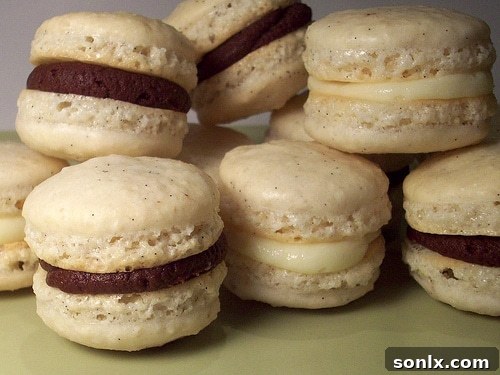
For my successful macaron attempt, I decided to embrace the classic elegance of vanilla bean. This choice allowed the delicate texture of the macaron shells to shine while providing a universally loved and sophisticated flavor profile. The tiny flecks of vanilla bean visible within the shells added a touch of visual sophistication, hinting at the exquisite taste within. To complement these aromatic shells, I prepared two distinct fillings, offering a delightful contrast and choice for anyone lucky enough to try them.
One half of the vanilla bean macarons was generously filled with a rich, velvety chocolate ganache. The deep, bittersweet notes of the chocolate provided a luxurious counterpoint to the subtle sweetness of the vanilla. The other half was filled with a smooth, luscious vanilla buttercream, enhancing the vanilla essence of the shells and creating a harmonious, melt-in-your-mouth experience. Both combinations were absolutely adorable, creating visually appealing treats that were as pleasing to the eye as they were to the palate. Each bite was, without exaggeration, a “little bite of heaven,” dissolving delicately in the mouth and leaving behind a lingering, delightful flavor. The ultimate proof of their success came when I brought the extra macarons into work; they vanished within minutes, devoured with gusto by appreciative colleagues. It was an incredibly rewarding moment, validating all the effort and learning.
Essential Resources and Tips for Aspiring Macaron Bakers
For anyone inspired to embark on their own macaron-making journey, I cannot stress enough the importance of comprehensive preparation and reliable resources. While the original Daring Bakers challenge recipe, available here, provides a solid foundation, my personal experience taught me the immense value of additional detailed guidance. After my initial setback, I turned to this incredibly detailed recipe and guide, which proved to be an invaluable tool. It offers in-depth explanations and troubleshooting tips that are crucial for demystifying the macaron process. I highly recommend consulting both resources if you’re serious about mastering these delicate confections.
Beyond specific recipes, here are some critical tips gleaned from my experience and extensive research:
- Read the Recipe Thoroughly: Before you even gather your ingredients, read the entire recipe multiple times. Understand each step, the why behind it, and anticipate potential challenges.
- Ingredient Precision is Paramount: Macarons are a science. Use a digital kitchen scale to weigh all ingredients, especially almond flour and powdered sugar, for accurate ratios. Do not rely on volume measurements.
- Aged Egg Whites: Separate your egg whites a day or two in advance and let them sit uncovered in the refrigerator. This dries them out slightly, leading to more stable meringue. Bring them to room temperature before use.
- Proper Meringue Consistency: Whether using the French or Italian method (the Fleming recipe uses French), whip your meringue to stiff, glossy peaks. It should hold its shape and not slide out if you invert the bowl.
- Master the Macaronage: This is the most crucial step. It’s the gentle folding of the almond flour mixture into the meringue. The goal is a batter that flows slowly, like lava, off your spatula, forming a “ribbon” that eventually dissipates back into the main batter after about 20-30 seconds. Over-mixing leads to flat, cracked shells; under-mixing leads to lumpy ones.
- Piping Technique: Use a round piping tip and pipe consistently sized circles onto parchment paper or silicone mats. Practice on a spare sheet first if you’re new to piping.
- The Drying Time (Resting/Casting a Skin): After piping, let your macarons sit at room temperature for 30-60 minutes (or longer, depending on humidity) until a skin forms. You should be able to gently touch the shell without the batter sticking to your finger. This step is vital for developing the “feet.”
- Oven Temperature is Key: Macaron ovens are precise. Too hot, and they crack; too cool, and they won’t form feet. An oven thermometer is your best friend. Some bakers rotate their trays halfway through baking for even results.
- Patience and Practice: Macarons are a journey. Don’t be discouraged by initial failures. Each attempt offers valuable lessons. Embrace the learning process, and celebrate even small improvements.
The Rewards of Persistence: Why Macarons Are Worth Every Effort
The journey to creating perfect French macarons is undoubtedly challenging, often fraught with moments of doubt and frustration. However, the reward for this persistence is profoundly satisfying. There’s an unparalleled sense of accomplishment that comes with successfully mastering a notoriously difficult bake, transforming raw ingredients into miniature works of edible art. The aesthetic beauty of neatly piped, perfectly ‘footed’ shells, coupled with their exquisite taste and delicate texture, makes them a truly special treat, far beyond the ordinary cookie.
Beyond the personal triumph, sharing these beautiful, delicious creations with others is an immense joy. Macarons elevate any occasion, whether it’s a simple afternoon tea or a celebratory gathering. They are not merely desserts; they are an expression of dedication and culinary finesse. This Daring Bakers challenge was more than just following a recipe; it was an education, a test of will, and ultimately, a testament to the idea that with enough research, effort, and a willingness to learn from mistakes, even the most intimidating baking goals are within reach. It’s an experience I wouldn’t trade for anything, and it instilled in me a deeper appreciation for the art and science of baking.