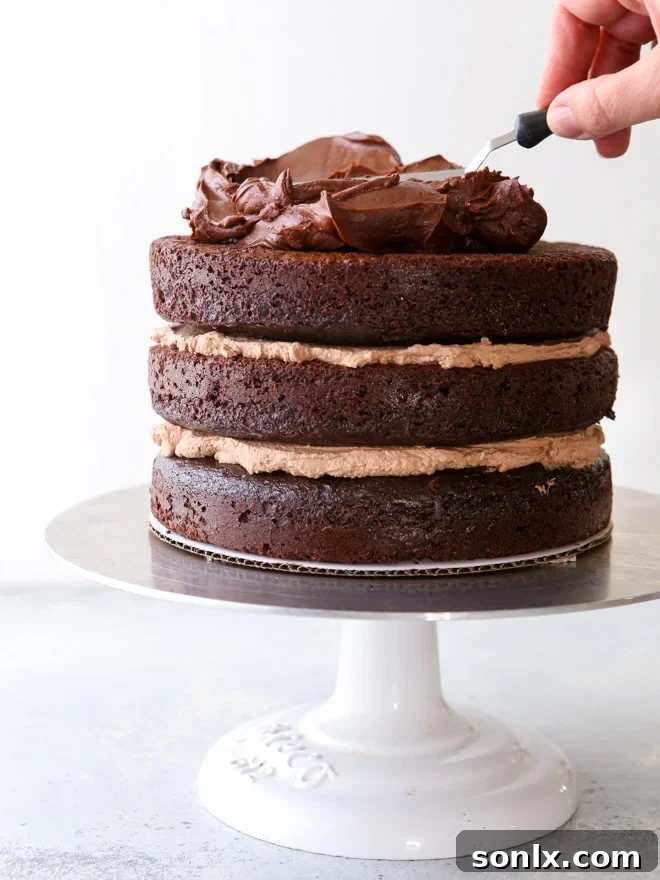
Embarking on the journey of baking a magnificent layer cake can seem daunting, but with the right guidance, it transforms into an incredibly rewarding experience. From meticulously preparing your cake pans to expertly applying the final swirl of frosting, this comprehensive guide will equip you with all the essential knowledge and techniques to construct a truly beautiful and delicious layer cake.
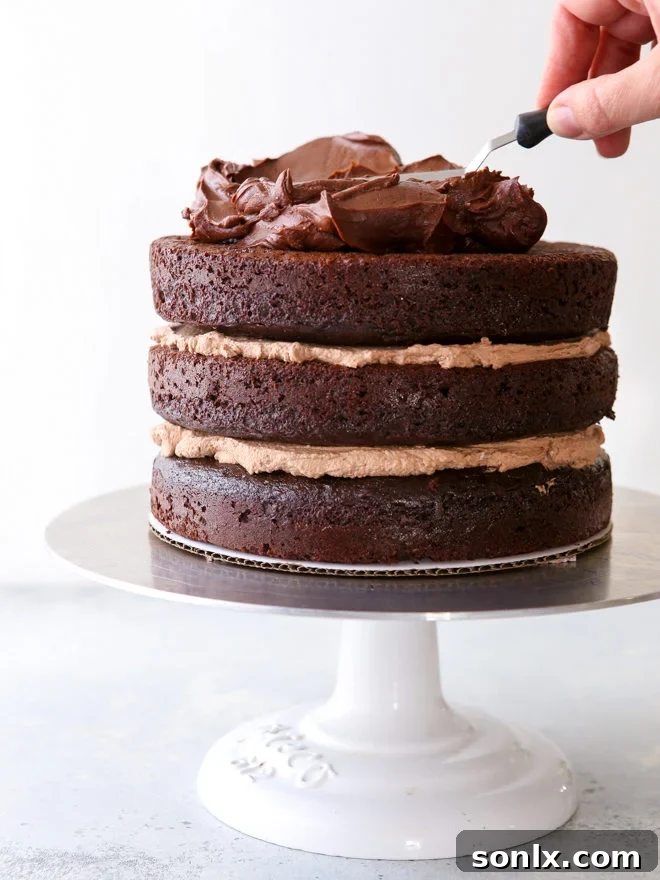
Let me confess, my path to mastering layer cakes wasn’t without its bumps and sugary detours. Oh no, I’ve certainly had my fair share of cake disasters – sinking centers, crumbling layers, and frosting nightmares! However, through years of dedicated practice, countless experiments, and invaluable tips gleaned from seasoned bakers and fellow bloggers, I’ve honed my skills. Today, I can confidently say that I possess the understanding and expertise required to build a flawless layer cake, a skill I’m thrilled to share with you.
I intentionally use the word “build” because, in my opinion, crafting a spectacular layer cake involves far more than just knowing how to frost. It encompasses a series of precise steps, each crucial to the final masterpiece. This guide will walk you through my proven method, from the very first ingredient preparation to the last decorative flourish. While there are countless ways to approach cake baking, this “my way” has consistently delivered exceptional results, and I believe it will empower you too.
Table of Contents
- Mastering Cake Pan Preparation for Flawless Layers
- Baking Perfectly Flat and Even Cake Layers
- Preparing and Storing Cake Layers in Advance
- Assembling Your Layer Cake with Confidence
- Achieving a Professional Frosting Finish
- Expert Tips for Storing and Transporting Your Cake
- Enjoy Your Masterpiece!
This comprehensive cake tutorial has been a staple on my blog since 2011, and over the years, I’ve refined and expanded each individual component into dedicated, in-depth posts. What was once an admittedly long-winded article has now evolved into a more digestible and user-friendly resource. But don’t worry, this guide acts as your central hub, linking you to those detailed tutorials whenever you need a deeper dive, ensuring you won’t miss a single crucial tip. Are you ready to transform your baking skills? Let’s get started!
(Disclosure: This post may contain affiliate links, which means I may receive a commission if you make a purchase through my links, at no extra cost to you. Thank you for supporting my blog!)
Mastering Cake Pan Preparation for Flawless Layers
The foundation of any successful layer cake lies in meticulous pan preparation. Nothing is more disheartening than spending time and effort on a beautiful batter, only for your cake layers to stick, tear, or crumble when you attempt to remove them from the pan. Proper pan prep is your absolute best defense against such baking disasters. Here are two foolproof steps to ensure your cake layers release perfectly every single time, setting the stage for a structurally sound and aesthetically pleasing final cake.
1) The Indispensable Role of Parchment Paper
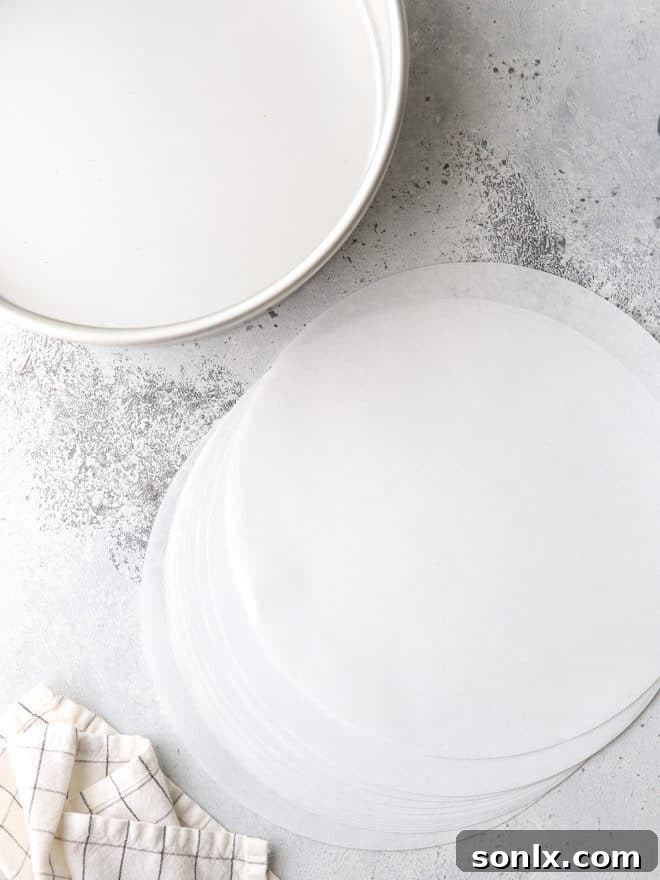
Without a doubt, the single most critical step in preparing your cake pans is to line them with parchment paper. This creates an impenetrable barrier between your delicate cake batter and the metal of the pan, guaranteeing that the bottom of your cake will not stick and will emerge intact. I literally never bake a cake without it! While you can certainly trace and cut full sheets of parchment paper to perfectly fit the base of your cake pans, a time-saving alternative is to purchase convenient pre-cut rounds of parchment paper that match standard pan sizes. Whichever method you choose, this step is non-negotiable for cake-baking success.
2) The Essential Grease and Flour Barrier (or Nonstick Spray)
Beyond parchment, creating an additional nonstick barrier along the sides of your cake pan is crucial. This ensures that the cake edges don’t cling to the pan as they bake and expand. You have two primary options for this:
- Butter and Flour (or Cocoa Powder): Generously coat the parchment-lined cake pan, including the sides, with a thin layer of softened butter (or margarine or shortening). Once buttered, dust the entire interior surface with all-purpose flour. Tap out any excess flour, leaving a fine, even coating. For chocolate cakes, consider using cocoa powder instead of flour to avoid a white residue on your dark cake layers. This classic method creates a perfect nonstick surface.
- Nonstick Baking Spray: For a quick and easy solution, a high-quality nonstick baking spray designed for baking (often containing flour) is highly effective. Products like Baker’s Joy are widely available at most grocery stores and offer excellent nonstick properties. For more heavy-duty or professional-grade options, you can explore restaurant supply stores, specialized baking shops, or purchase them conveniently online. Ensure you spray thoroughly, covering all inner surfaces of the pan.
The combination of parchment paper on the bottom and a greased-and-floured (or sprayed) surface on the sides guarantees that your beautifully baked cake layers will slide out effortlessly, preserving their integrity and leaving you with perfect foundations for your layer cake.
Seeking more detailed assistance and visual step-by-step photos? Don’t miss my comprehensive guide on how to keep cake from sticking to the pan, which delves deeper into these techniques.
Baking Perfectly Flat and Even Cake Layers
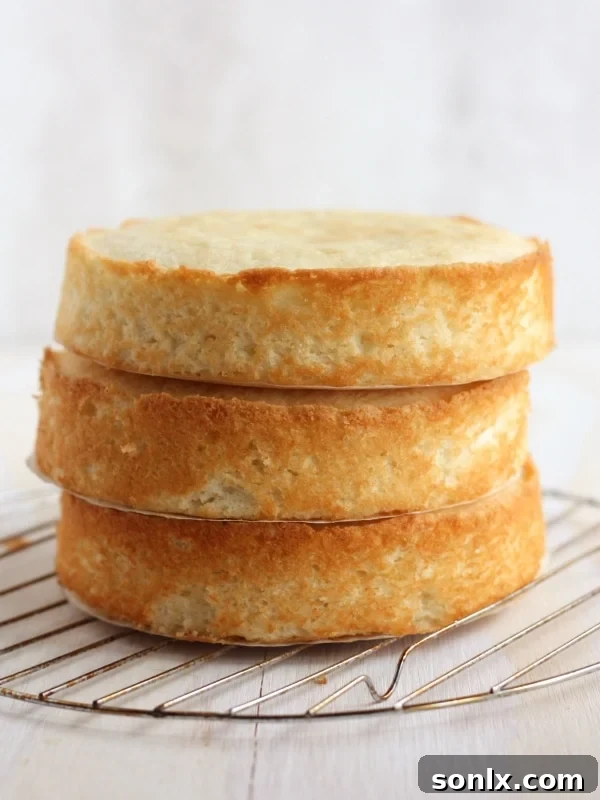
Once your pans are meticulously prepped and your delicious cake batter is ready, the exciting moment of baking arrives! While you could simply pour the batter into the pans, two remarkably simple yet highly effective tricks will elevate your baking game, ensuring every cake layer bakes up uniformly flat and precisely the same size. This consistency is absolutely paramount for effortless assembly and a stunning final presentation, eliminating the need for excessive trimming.
1) Precision with a Digital Scale for Even Batter Distribution
In baking, precision is a virtue, and using a digital kitchen scale is an invaluable tool for achieving perfectly even cake layers. After mixing your batter, place each prepared cake pan on the scale and pour in the batter, noting the weight. Distribute the batter equally among all pans, ensuring each pan contains the exact same amount by weight. This simple step guarantees that every layer will rise and bake to the same height and diameter, providing a level foundation for stacking and dramatically simplifying the assembly process.
2) The Secret to Flat Tops: Adjusting Baking Temperature
Many bakers grapple with domed cake tops, which require trimming and can lead to wasted cake. While various methods exist to prevent this, my favorite technique requires no special tools and is incredibly effective: simply reduce your oven temperature. The science behind it is straightforward: a lower baking temperature slows down the “oven spring” – the initial rapid rise of the cake. This allows the cake to bake more evenly from the edges to the center, preventing the outer edges from setting too quickly while the center continues to rise, thus eliminating the dreaded dome.
Here’s how to implement this adjustment:
- Standard Recipe Instruction: If your recipe calls for baking at 350°F (175°C) for 30 minutes.
- Adjusted Method: Reduce the temperature by 25°F (approx. 15°C). So, bake at 325°F (160°C).
- Adjusted Baking Time: Increase the baking time by approximately one-half. So, for a 30-minute original time, you would add 15 minutes, making the total baking time 45 minutes.
For example, if the recipe specifies 350°F for 30 minutes, you would instead bake at 325°F for a total of 45 minutes (30 min + 15 min). I always recommend peeking in on the cakes around the original baking time, then checking every 5 minutes thereafter with a toothpick or by gently pressing the center to ensure they are baked through but not over-baked. This method is surprisingly accurate and will consistently yield beautiful, flat cake layers without any extra fuss.
For a deeper dive into this technique and more visual guides, consult my complete tutorial on how to bake flat cake layers.
Preparing and Storing Cake Layers in Advance
Building an impressive layer cake often benefits from a thoughtful, multi-day approach. Personally, I find that baking the cake layers on one day and allowing them to thoroughly chill, ideally overnight in the fridge, makes the assembly process significantly smoother. Cold, firm cake layers are much easier to handle, less prone to tearing or crumbling, and hold their shape beautifully during frosting. Furthermore, life happens, and sometimes planning even further ahead is a necessity. Here are two effective strategies for storing your perfectly baked cake layers in advance, ensuring freshness and convenience.
1) Short-Term Storage in the Refrigerator
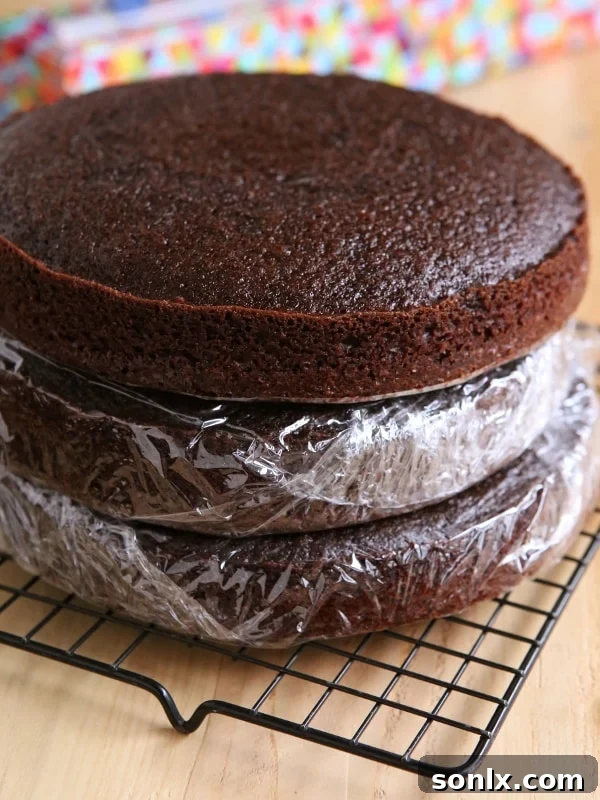
The refrigerator is an excellent environment for short-term storage of individual cake layers. Once your cake layers have completely cooled to room temperature, wrap each layer tightly and individually in several layers of plastic wrap. Ensure the plastic wrap creates an airtight seal to prevent any moisture loss and to shield the cake from absorbing unwanted fridge odors. Stored in this manner, your cake layers will remain fresh and moist in the refrigerator for 3 to 5 days, ready for assembly when you are.
2) Long-Term Storage in the Freezer
Did you know cake layers freeze exceptionally well? The freezer is your best friend if you need to store your layers for more than a few days, or if you’re planning to bake in batches. To prepare for freezing, ensure each cooled cake layer is double-wrapped very tightly in plastic wrap, then an additional layer of aluminum foil for extra protection against freezer burn. Properly wrapped, cake layers can be frozen for up to 1 month, and often even longer without compromising quality. Freezing can also enhance moisture by locking it in.
To thaw frozen cake layers, transfer them from the freezer to your countertop. Let them sit at room temperature, still in their wrappings, for several hours or even overnight. It’s best to place them side-by-side, rather than stacked, to ensure even thawing. The condensation that forms on the outside of the wrapping will be reabsorbed by the cake as it thaws, contributing to its moist texture. Once thawed, you can transfer them to the fridge if you prefer to work with chilled layers, or proceed directly to assembly.
By leveraging these advanced preparation and storage techniques, you can effectively streamline your baking schedule, reduce stress on assembly day, and consistently produce a superior layer cake with perfect texture and structure.
For detailed instructions and helpful step-by-step photos on preserving your cake layers, explore my complete guide on how to store and freeze cake layers.
Assembling Your Layer Cake with Confidence
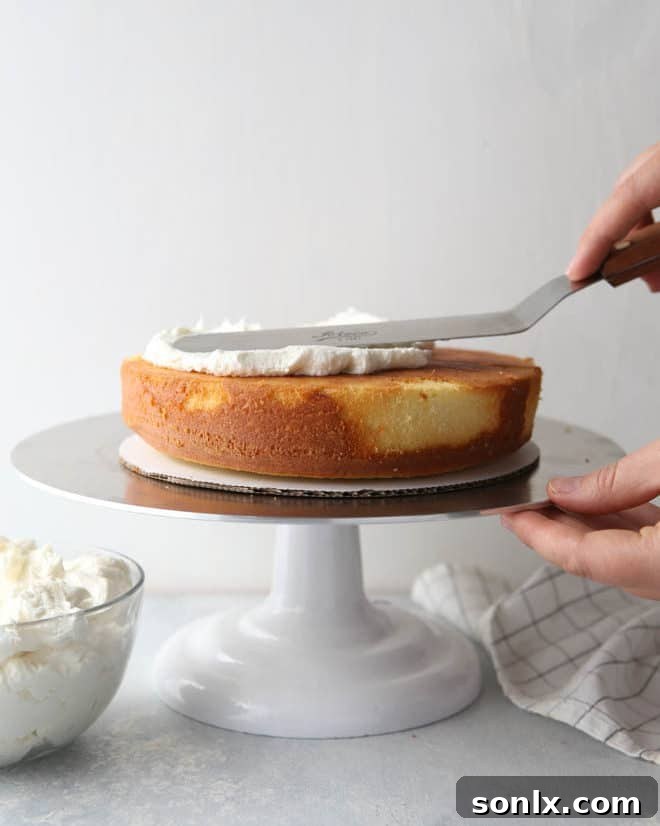
Assembling a layer cake is where all your careful preparation comes together. While not strictly essential, investing in a few key tools can dramatically improve your experience and the final outcome. I highly recommend using a turntable (or revolving cake stand) and cardboard cake rounds. The cake rounds provide a sturdy base, making it incredibly easy to transfer your cake from the fridge to your final cake stand without damaging it. A turntable, on the other hand, is a game-changer for frosting, allowing for smooth, even application with minimal effort.
1) Establishing a Stable Foundation
To begin assembly, place your first cooled and preferably chilled cake layer top-side down onto a cardboard cake round. Alternatively, you can place it directly onto your chosen cake stand or serving plate if you prefer not to use a round. Orienting the layer top-side down ensures you have the flattest, smoothest surface as your cake’s base, contributing to overall stability and a professional finish.
2) Layering Frosting or Filling
Next, evenly spread a generous layer of your chosen frosting or filling over the first cake layer. For an 8 or 9-inch cake, approximately 1 cup of frosting or filling is a good starting point. Use an offset spatula to spread it smoothly to the edges.
If you’re working with a softer, more fluid filling such as lemon curd, fruit preserves, or a delicate pastry cream, it’s crucial to create a “dam” of frosting around the perimeter of your cake layer first. This dam acts as a protective barrier, preventing the softer filling from oozing out the sides when the next cake layer is added. You can create this dam using a piping bag fitted with a round tip for precision, or simply use an offset spatula to build a slightly raised border of frosting around the edge before spooning in your soft filling.
3) Repeating and Advanced Layering Techniques
Continue this process: place the next cake layer on top, spread frosting/filling, and repeat until all layers are stacked. Always ensure each layer is centered before pressing down gently.
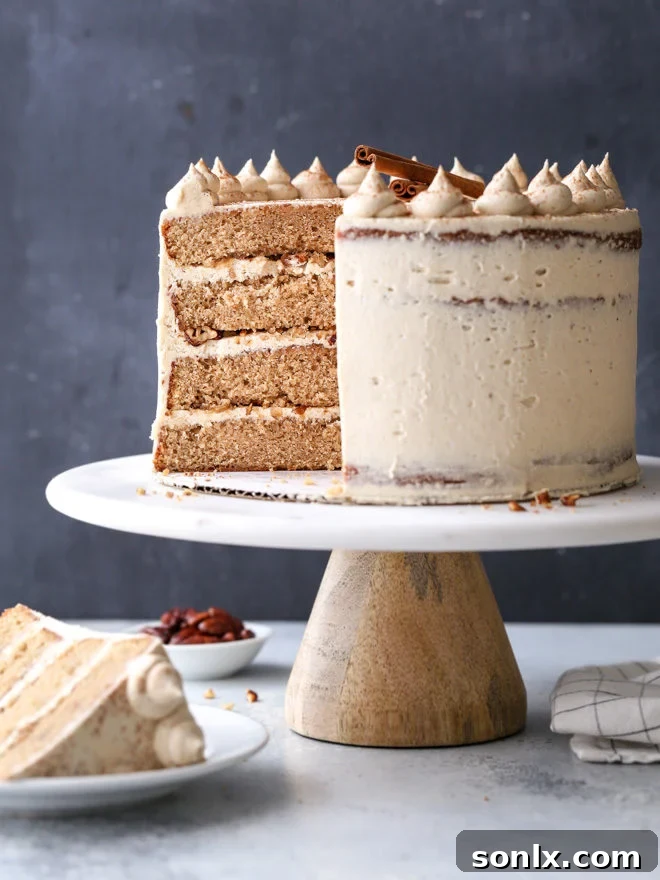
For those looking to create a taller, more intricate cake with more filling-to-cake ratio, you might consider splitting your cake layers horizontally. For example, two standard cake layers can be expertly split to create four thinner layers. To achieve this:
- Score the Cake: Use a long, sharp serrated knife to lightly score a horizontal line all the way around the circumference of the cake layer, at the desired halfway point. This acts as your guide.
- Slice Evenly: With the scored line as your guide, carefully use the serrated knife to cut through the cake layer horizontally, keeping the knife level. Slowly rotate the cake as you cut, ensuring an even split.
Working with chilled layers makes splitting much easier, resulting in cleaner cuts. This technique allows for more delightful layers of filling and a more dramatic presentation.
For visual assistance and detailed step-by-step photos on how to perfectly split your cake layers, refer to my complete guide on how to cut a cake into even cake layers.
Achieving a Professional Frosting Finish
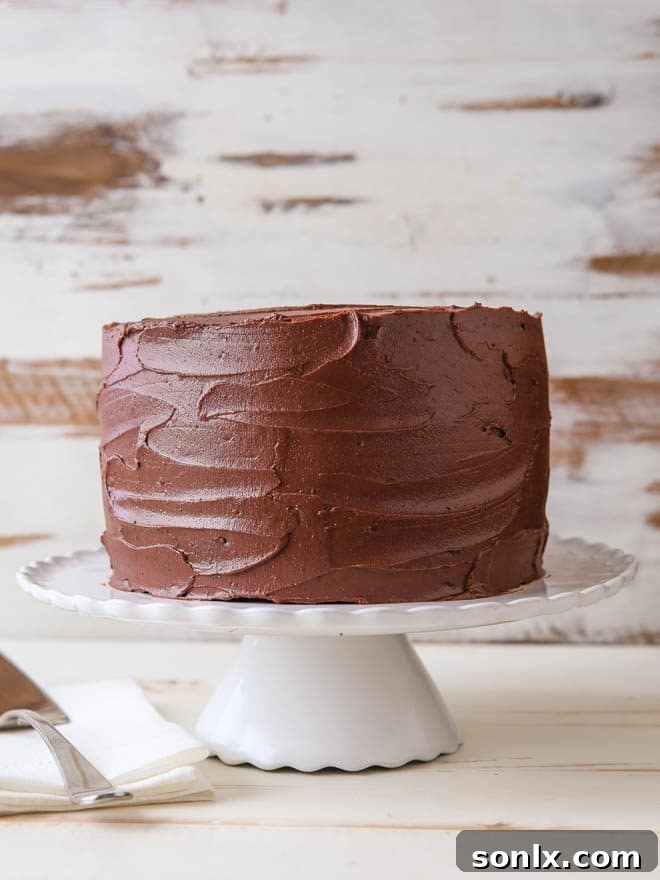
Frosting a cake is often seen as the most challenging part, but it can be incredibly satisfying with the right technique. The absolute most important secret to a perfectly smooth and crumb-free final frosting coat is the “crumb coat.” This thin, initial layer of frosting is what truly takes your layer cakes from amateur to professional, sealing in any loose crumbs and evening out the cake’s shape. It doesn’t need to be thick or perfectly smooth; in fact, a slightly messy crumb coat is perfectly acceptable. The popular “naked cake” aesthetic that highlights the cake layers themselves often consists of little more than a beautifully executed crumb coat.
1) The Essential Crumb Coat Application
Once your cake layers are assembled and firm (chilled layers are highly recommended for this step), begin applying a thin, even layer of frosting over the entire cake – starting at the top and working your way down the sides. Your goal here is not beauty, but functionality: fill in any gaps between layers, smooth out minor imperfections, and most importantly, trap any loose crumbs. If your frosting is particularly stiff, you might find it easier to work with by thinning it slightly with a tablespoon or two of milk (or cream, depending on your frosting type). Use an offset spatula or a bench scraper to spread it thinly and evenly. Don’t worry if it looks a bit rough; its purpose is purely foundational. Once applied, place the cake in the refrigerator for at least 30 minutes to allow the crumb coat to firm up completely. This chilling period is crucial as it sets the crumbs firmly in place, preventing them from mixing into your final decorative layer.
2) Applying the Final, Flawless Coat
After your crumb coat has chilled and firmed up, it’s time for the final, thicker coat of frosting. This is where you focus on achieving a smooth, polished finish. Again, start by spooning a generous amount of frosting onto the top of the cake, then spread it evenly to the edges. Next, apply frosting to the sides, ensuring good coverage. For the smoothest possible finish, I highly recommend using an offset spatula for the top and a long bench scraper for the sides. If you’re using a turntable, it becomes an indispensable tool here: keep the scraper stationary and rotate the cake, applying gentle, consistent pressure to achieve incredibly smooth, even sides. For the top, glide your offset spatula from the outer edge towards the center, cleaning excess frosting with each stroke. If the frosting starts to drag, warm your spatula slightly in hot water and dry it before continuing. Aim for long, gentle strokes to minimize lines and maximize smoothness. Once satisfied with the finish, chill the cake in the refrigerator for at least another 30 minutes to allow the final frosting layer to set, which makes it easier to handle and transport, and gives it a more professional appearance.
For an in-depth exploration of frosting techniques, complete with helpful images and step-by-step guidance, be sure to read my comprehensive tutorial on how to frost a layer cake.
Expert Tips for Storing and Transporting Your Cake
You’ve put in all the effort to bake and decorate a stunning layer cake; now it’s essential to ensure it stays fresh and arrives safely at its destination. Proper storage and careful transportation are the final steps in preserving your culinary masterpiece.
Storing Your Finished Cake
I always recommend storing finished layer cakes in the refrigerator. Chilling helps to keep the cake cold and firm, especially if your frosting contains butter, cream cheese, or other perishable ingredients. This firming also protects the cake’s delicate structure and decorations from accidental bumps and curious fingers. Depending on the ingredients and frosting type, most frosted cakes will keep beautifully in the fridge for up to several days. For optimal freshness, ensure your cake is covered. A dome-shaped cake keeper is ideal, but loosely covering it with plastic wrap without touching the frosting (you can use toothpicks to create a tent) also works. Once the cake has been cut, the exposed surfaces are prone to drying out. To combat this, gently press plastic wrap directly onto the cut edges of the cake. This helps to lock in moisture and maintain its delicious texture.
Transporting Your Cake Safely
Transporting a beautifully decorated layer cake requires a bit of planning and care, especially for longer distances or warmer weather. Here are my top tips:
- Chill Thoroughly: Before any transport, chill your assembled and frosted cake in the refrigerator for at least 1-2 hours, or even longer, until it is truly solid. A firm, cold cake is much less likely to shift, melt, or get damaged during transit. Only remove it from the fridge just before you depart.
- Secure Packaging: Place your cake in a sturdy box specifically designed for cakes, or a dedicated cake keeper. Ensure the cake cannot slide around within the box. You can use non-slip mats or a small dab of frosting on the bottom of the cake board to secure it to the box base.
- Temperature Control: If traveling a long distance or in warm conditions, consider using insulated bags or coolers (without direct ice contact) to help maintain the cake’s chilled state. Air conditioning in the car is also crucial.
- Smooth Ride: Place the cake on a flat, stable surface in your vehicle – the floor of the passenger seat or the trunk is often better than a wobbly seat. Drive smoothly, avoiding sudden stops, sharp turns, or bumpy roads.
- Dowel Support for Large Cakes: For larger, heavier cakes (generally multi-tiered cakes or single cakes larger than 10 inches in diameter) or those with delicate decorations, consider inserting structural dowels or supports into the lower layers before frosting. These dowels help to bear the weight of the upper layers, preventing them from sinking or shifting, and greatly enhance the cake’s stability during transportation. Ensure dowels are cut to the exact height of the cake layers they support.
By following these guidelines, you can ensure your hard work is preserved, and your magnificent layer cake arrives at its destination in perfect condition, ready to impress.
Enjoy Your Masterpiece!
And there you have it! Through careful preparation, precise baking, confident assembly, and artistic frosting, you have successfully built a stunning layer cake. This tutorial aims to demystify the process, breaking it down into manageable and achievable steps that empower every home baker. Each stage, from the initial pan prep to the final flourish of frosting, plays a vital role in creating a cake that is not only visually impressive but also structurally sound and, most importantly, incredibly delicious.
Remember, baking is both a science and an art, and practice truly makes perfect. Don’t be discouraged by minor imperfections along the way; each bake is a learning opportunity. The joy of creating something beautiful from scratch and sharing it with loved ones is truly unparalleled. I sincerely hope you found this comprehensive guide helpful and inspiring.
Now, take a moment to admire your creation, slice into its perfectly even layers, and savor every bite. If you have any personal tips, tricks, or insights you’ve discovered in your own baking journey, please feel free to share them in the comments section below. Happy baking!
This post was originally published in February 2011 and has since been extensively updated with enhanced photos, expanded content, and refined techniques to provide the most current and valuable information possible.