Mastering the Art of Even Cake Layers: A Simple Guide to Horizontal Cake Slicing
Transforming a simple cake into a stunning, multi-layered masterpiece is a game-changer for any baker. More cake layers not only create a visually impressive, taller cake but also allow for a more balanced cake-to-filling ratio in every slice, leading to an exquisite eating experience. Imagine the gasps of delight and appreciative “oohs” and “aahs” from your friends and family as you effortlessly slice into a beautifully constructed layer cake. While baking each individual layer separately is an option, it often presents challenges with limited cake pans, oven space, or simply the desire to optimize baking time. This is where the invaluable technique of splitting a single cake layer horizontally comes into play – a fundamental skill that elevates your baking prowess and unlocks endless creative possibilities.
The culinary world offers a myriad of ingenious suggestions for achieving perfectly divided cake layers. From investing in specialized cake leveling tools that promise precision with minimal effort, to clever kitchen hacks involving toothpicks as guides, or even the surprising effectiveness of unflavored dental floss for a clean cut, the options are plentiful. However, after extensive experimentation and countless cakes, I’ve discovered a method that consistently delivers exceptional results without the need for any fancy gadgets or obscure techniques. This approach is not only incredibly easy and remarkably accurate but also relies solely on basic kitchen knives you likely already own. It’s my go-to technique for ensuring every layer cake I bake is a testament to evenness and professional presentation. Let’s delve into this straightforward yet highly effective method that will revolutionize your layer cake game.
Essential Tools and Preparation for Perfect Cake Layers
Before you embark on your cake-splitting journey, ensuring you have the right tools and that your cake is properly prepared will set you up for success. You won’t need an arsenal of specialized equipment, just two key knives: a small, sharp paring knife and a large, sturdy serrated knife. The paring knife will act as your precision guide, initiating the cut, while the serrated knife will smoothly complete the division.
The state of your cake is arguably the most crucial factor. For optimal results, your cake layers absolutely must be chilled. A cold cake is significantly firmer and less prone to crumbling or tearing than a cake at room temperature. This increased rigidity provides the stability you need for a clean, even cut. My preferred strategy is to bake my cake layers the day before I plan to assemble the cake. Once cooled, I wrap them tightly in plastic wrap and store them in the refrigerator overnight. This allows them ample time to firm up, making them a joy to work with when it’s time to slice.
Another vital prerequisite for flawlessly even layers is a flat top. While some bakers embrace a slight dome, a perfectly level surface is essential for stacking without wobbling and for ensuring each divided layer is of uniform thickness. I often employ a simple trick to achieve impeccably flat cake tops right out of the oven. However, if your cake layers do emerge with a noticeable dome, don’t fret! Simply use your large serrated knife to carefully trim off the domed top, creating a level surface before proceeding with the horizontal cut. Place the cake on a rotating cake stand if you have one, or simply turn it slowly on your counter, using a gentle sawing motion to shave off the dome. This step, while seemingly minor, makes a significant difference in the final presentation and stability of your layered cake.
Finally, consider the thickness of your cake layers. While this method is adaptable, I find it yields the best and easiest results when working with cake layers that are at least 2 inches (approximately 5 cm) tall. Thinner cake layers can be more challenging to divide evenly without inadvertently cutting through them or causing breakage. The added height provides a more substantial canvas for your knives, making the scoring and slicing process much more forgiving. With your chilled, flat-topped, and adequately thick cake layers ready, you’re perfectly positioned to begin. Let’s get started on creating those beautifully even layers!
Step 1: Creating Your Precision Guide with a Paring Knife
The first step is arguably the most critical for ensuring an even cut, as it sets the foundation for accuracy. Take your small paring knife and begin to score the entire outside edge of your cake layer. The goal here is to create a shallow, continuous indentation halfway up the side of the cake. This indentation will serve as your visual and tactile guide, helping you maintain a perfectly horizontal cut as you proceed to the next step. To achieve the best results, place the cake on a stable surface or, ideally, a rotating cake stand if you have one. Position yourself at eye-level with the cake – this perspective is essential for accurately gauging the halfway point and keeping your cut perfectly level. Slowly and steadily, rotate the cake with one hand while gently guiding the tip of the paring knife around its circumference with the other. The key here is not to cut too deeply; this is merely a marker, a faint line that will tell you exactly where to guide your larger knife. Aim for a consistent depth, perhaps just a millimeter or two deep. Resist the urge to rush; precision in this initial scoring phase will pay dividends in the final outcome. Taking your time here ensures that your two resulting cake layers will be of equal thickness, forming the perfect foundation for your magnificent tiered creation.
Step 2: Executing the Horizontal Slice with a Serrated Knife
With your guiding score line meticulously etched, it’s time to make the main cut. Pick up your large serrated knife. The serrations are crucial here, as they allow the blade to saw through the cake with minimal resistance, creating a clean cut without tearing or compressing the delicate crumb. Position the serrated knife so its edge aligns perfectly with the indentation you made in Step 1. Begin to saw gently and slowly through the cake, following that established guideline. Imagine you are cutting through butter – a smooth, steady, back-and-forth motion is far more effective than trying to push the knife straight through. As you cut, rotate the cake, keeping the knife level and ensuring it stays within the scored line. This rotating motion, combined with the gentle sawing, helps maintain accuracy and prevents the knife from dipping or rising, which could lead to uneven layers. Take your time; there’s absolutely no need to rush this process. The goal is a uniform, straight cut from one side of the cake to the other. If you feel the knife starting to drift, gently adjust its angle. Patience and a consistent hand will result in two perfectly even cake layers, ready for filling and stacking.
Step 3: Gently Separating Your Evenly Divided Cake Layers
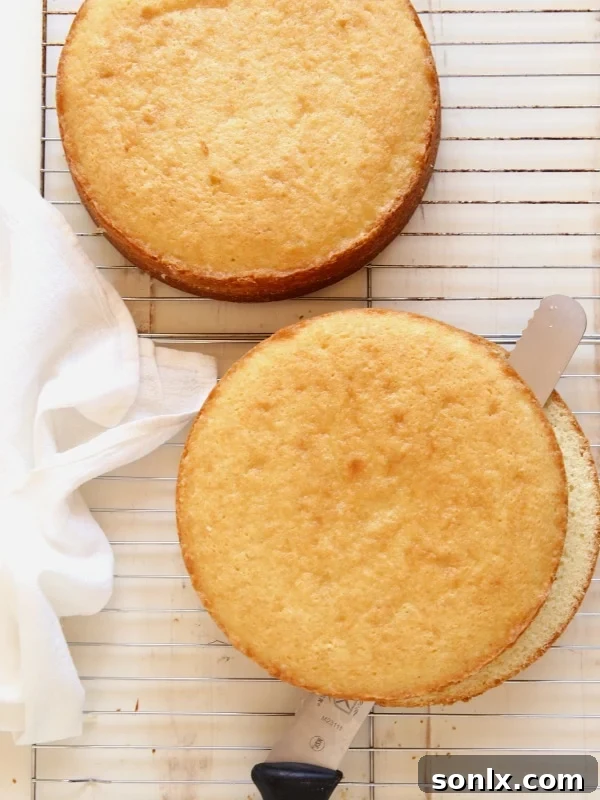
Once you’ve made a complete cut through the cake, you’ll have two distinct layers, but they’ll still be resting on top of each other. The final step is to carefully lift the top layer off the bottom. For most chilled cakes, especially those 8 or 9 inches in diameter or smaller, you should be able to gently slide your large serrated knife or a thin cake lifter underneath the top layer and lift it with relative ease. The chilled nature of the cake provides ample sturdiness, minimizing the risk of buckling, tearing, or crumbling during this separation. Place the lifted layer onto a separate plate or a piece of cardboard cut to size, ready for assembly.
However, if you’re working with a particularly large cake round, say 10 inches or more, or if your cake layers are on the thinner side, you might need to exercise a little extra caution. In these scenarios, using two spatulas or a large, flat cake lifter might be beneficial. Slide one spatula from one side and another from the opposite, meeting in the middle to provide maximum support as you lift. This prevents the larger, more delicate layer from bending or breaking under its own weight. Always lift smoothly and confidently, but gently. With practice, this motion will become second nature, and you’ll find yourself effortlessly creating multiple, perfectly even cake tiers.
Storing Your Freshly Divided Cake Layers for Future Baking
Once your cake layers are divided, you have a couple of options for their immediate use or storage. If you’re ready to proceed with assembly, use your newly divided layers immediately to build a magnificent layer cake. The fresh cut surface is ideal for absorbing syrups or adhering to frosting. If you’re not assembling your cake right away, proper storage is key to maintaining freshness and texture. Wrap each individual cake layer tightly in plastic wrap. Ensure there are no exposed areas to prevent drying out. These individually wrapped layers can be stored in the refrigerator for up to 5 days. For longer storage, you can freeze your cake layers. To do this, wrap each layer twice in plastic wrap, then add an additional layer of aluminum foil for extra protection against freezer burn. Stored this way, your cake layers will remain fresh and delicious in the freezer for up to 1 month, ready to be thawed and transformed into an impressive dessert whenever the craving strikes.
Why This Method Outshines Others
While various techniques exist for dividing cake layers, this knife-based method offers several distinct advantages. Unlike specialized cake levelers, which can be inconsistent or difficult to use with cakes of varying textures, this approach provides universal applicability. Dental floss, while clever, can sometimes leave an impression on softer cakes or struggle with denser crumb structures. The toothpick method requires setting multiple guides, which can be tedious and still prone to slight variations. Our method, leveraging the simple precision of a paring knife for an initial score and the clean cutting power of a serrated knife, empowers the baker with direct control and visual feedback at every stage. It’s a low-cost, high-reward technique that builds confidence and delivers consistent professional results, making it superior for home bakers looking to elevate their craft.
Expert Tips for Flawlessly Even Cake Layers
- Keep Your Knives Sharp: A sharp paring knife creates a cleaner score, and a sharp serrated knife will cut through the cake with less effort and more precision, reducing the chance of tearing.
- Steady Hand is Key: Practice makes perfect. If you’re new to this, start with a practice cake or even a dense loaf of bread to get a feel for the motion.
- Use a Rotating Turntable: A cake turntable is a baker’s best friend for this task. It allows you to smoothly rotate the cake while keeping your cutting hand steady and focused on maintaining a level line.
- Clean Your Knife: If you’re cutting multiple layers, occasionally wipe your serrated knife clean between cuts. This prevents crumbs from building up and causing an uneven drag or sticky residue.
- Chill Thoroughly: Reiterate the importance of a well-chilled cake. Even a slightly cool cake is better than one at room temperature, but fully chilled is ideal.
Common Mistakes to Avoid When Slicing Cake Layers
Even with the best instructions, it’s easy to fall into common traps when slicing cake layers. One frequent error is rushing the initial scoring step. A hurried score can result in an uneven starting line, which will inevitably lead to lopsided layers. Another mistake is using too much pressure with the serrated knife, attempting to push through the cake rather than employing a gentle sawing motion. This can compress the cake, creating a dense line through the layer or even causing it to tear. Not getting down to eye level is also a common oversight; without this perspective, it’s incredibly difficult to ensure your knife is perfectly horizontal. Lastly, trying to cut a warm or even slightly warm cake will almost certainly result in crumbling and a messy, uneven cut. Always prioritize patience, precision, and proper cake preparation to avoid these pitfalls and achieve beautifully divided layers every time.
Conclusion: Elevate Your Baking with Perfect Layers
Mastering the art of cutting cake layers horizontally is more than just a technique; it’s a foundational skill that opens up a world of possibilities for stunning cake creations. By following this simple, effective method, you can effortlessly transform a single cake layer into two (or even three!) perfectly even tiers, ready to be filled with decadent frostings, luscious fruit purees, or rich ganaches. This not only enhances the visual appeal of your cakes but also provides a superior eating experience, with a delightful balance of cake and filling in every bite. No longer will you be limited by the number of pans you own or worry about uneven stacks. Embrace this easy, accurate, and equipment-free technique, and watch as your layer cakes transition from homemade to bakery-quality masterpieces. So go ahead, chill those cakes, sharpen those knives, and prepare to impress everyone with your newfound layering prowess. Your next show-stopping cake is just a few simple cuts away!