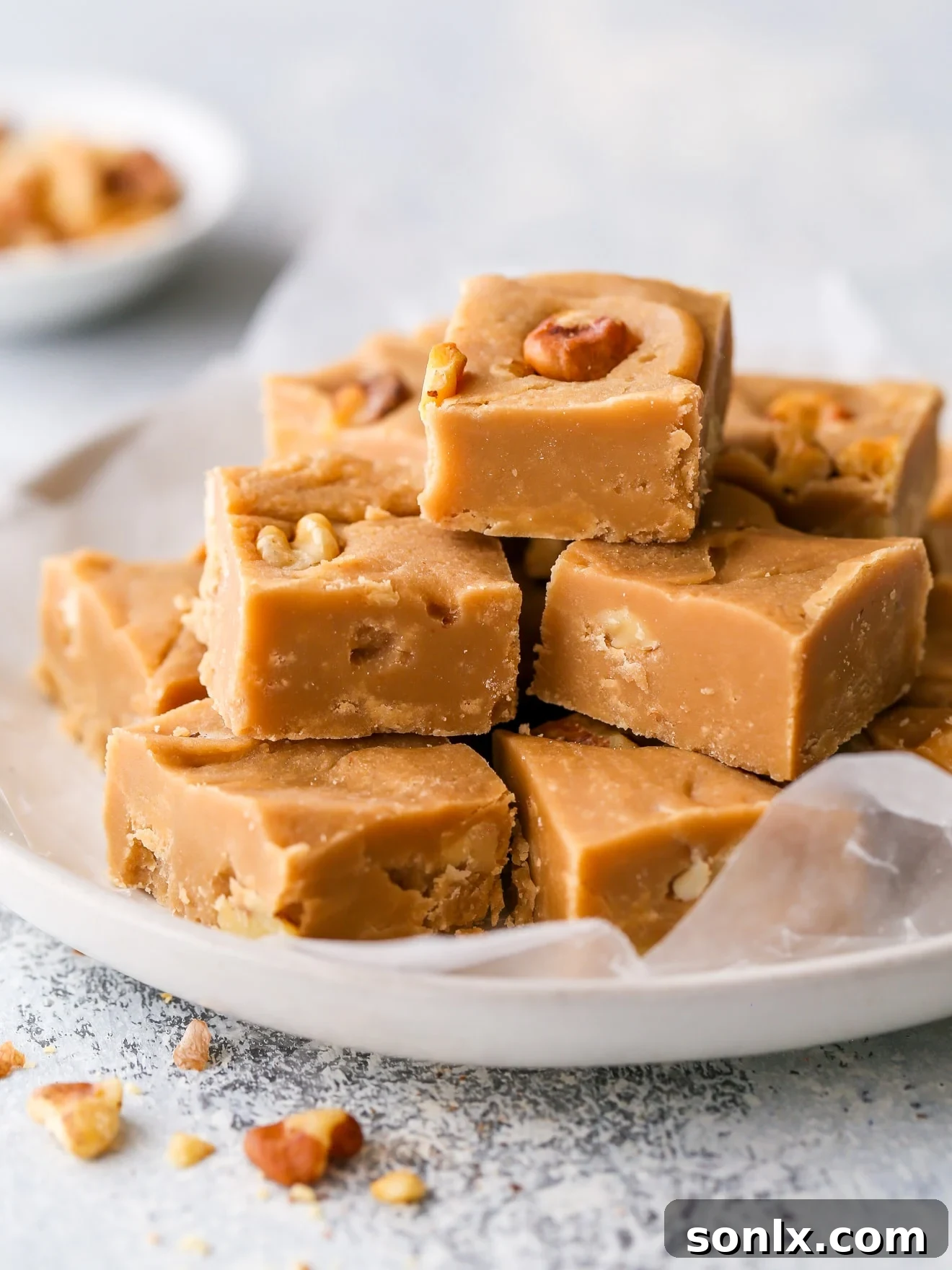
Step into the delightful world of old-fashioned confectioneries with our irresistible Brown Sugar Fudge recipe. Also affectionately known as Penuche, this timeless treat stands out with its rich, smoky caramel flavor and a satisfying hint of crunch from toasted walnuts. Unlike its chocolate counterpart, brown sugar fudge offers a unique depth of sweetness and a velvety smooth texture that simply melts in your mouth. If you’re searching for a classic candy that evokes warmth and nostalgia, this easy-to-follow recipe promises a truly delicious and utterly irresistible experience.
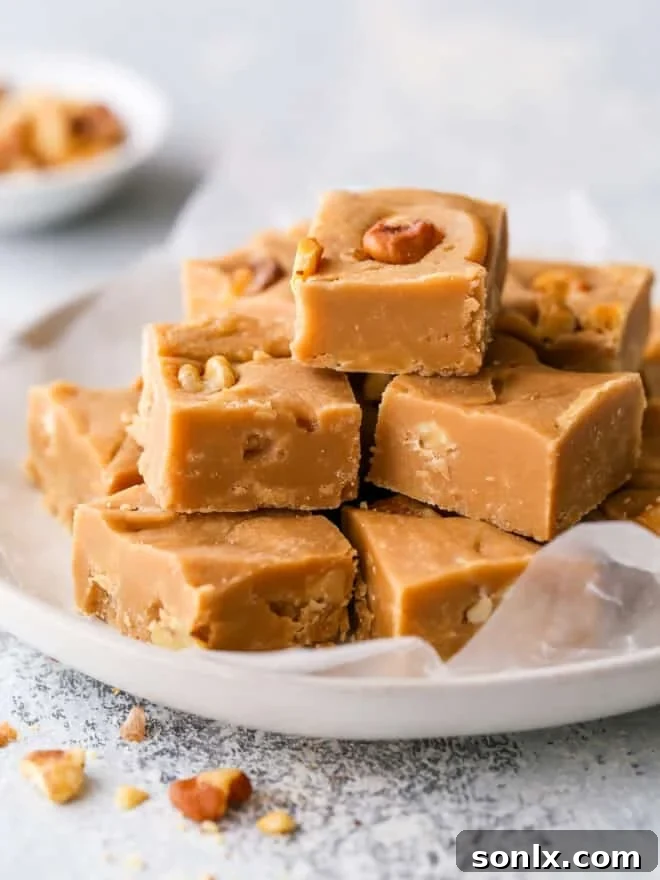
Fudge holds a special place in the hearts of dessert lovers worldwide, and while chocolate fudge often takes the spotlight, this brown sugar rendition is a true contender for the top spot. Its luxurious, sweet profile is perfectly balanced by that distinctive caramel undertone derived from brown sugar, making every bite a memorable one. The optional addition of perfectly toasted walnuts introduces a delightful textural contrast and a nutty aroma that elevates the entire experience. Whether you’re an experienced candy maker or a novice, this straightforward recipe is designed for success and is well worth the effort for its incredible flavor and rewarding results.
This delectable fudge isn’t just a simple dessert; it’s a versatile treat perfect for a multitude of occasions. Imagine sharing this exquisite candy at your next holiday gathering, as a centerpiece on a Christmas dessert platter, or carefully packaged as a thoughtful homemade gift. Its elegant flavor and rustic charm make it ideal for festive celebrations, potlucks, or simply as a comforting indulgence on a quiet evening. You can certainly omit the walnuts if you prefer a smoother texture, but their subtle crunch and earthy notes genuinely complement the sweet, creamy fudge.
Table of Contents
- The Allure of Brown Sugar Fudge
- Essential Ingredients for Perfect Penuche
- Why Evaporated Milk is Key in Fudge Making
- Mastering Fudge with a Candy Thermometer
- Step-by-Step Guide: How to Make Brown Sugar Fudge
- Expert Tips for Fudge Making Success
- More Delectable Candy Recipes to Explore
- Brown Sugar Fudge Full Recipe
The Allure of Brown Sugar Fudge (Penuche)
What makes brown sugar fudge, or penuche, so utterly captivating? It’s not just a candy; it’s an experience. The magic lies in the brown sugar itself, which, unlike white granulated sugar, brings a depth of molasses flavor and a subtle acidity that caramelizes beautifully. This creates a more complex, almost smoky sweetness that is undeniably addictive. Each bite of this creamy confection delivers a rich, buttery taste, often enhanced by the delightful texture of toasted walnuts. It’s a taste that transports you back to simpler times, making it a beloved staple for generations. Whether you call it brown sugar fudge or penuche, its charm is universal, offering a comforting warmth that makes it a perfect treat for any season, especially during the festive holiday months.
Essential Ingredients for Perfect Penuche
Gathering your ingredients is the first exciting step towards creating this divine brown sugar fudge. Simplicity is at its core, yet each component plays a crucial role in achieving that perfect, melt-in-your-mouth consistency and rich flavor. You’ll find the full, detailed recipe with exact measurements at the end of this article, but for now, let’s look at the key players you’ll need to prepare.
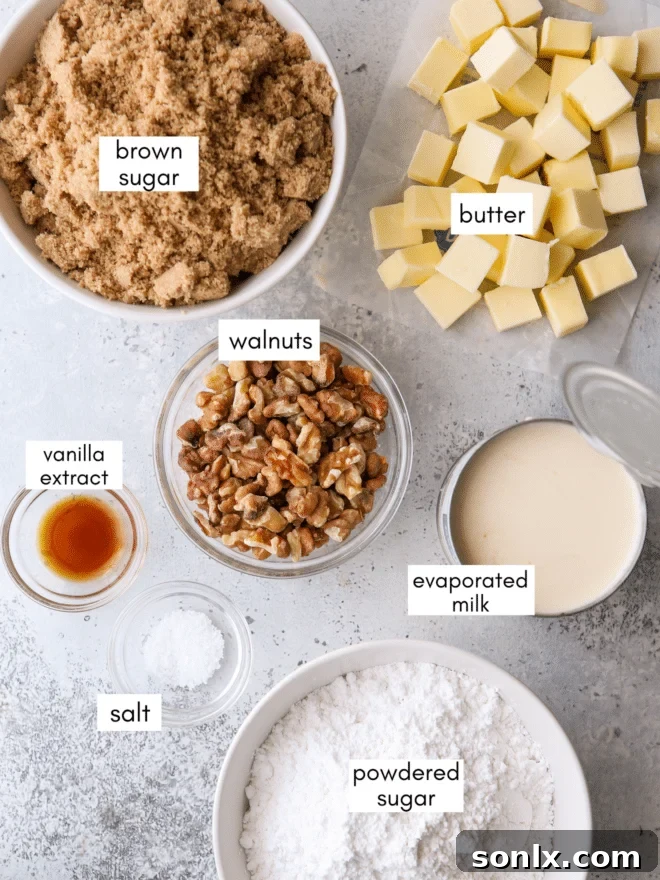
You’ll be working with everyday pantry staples, ensuring that this gourmet treat is accessible to everyone. The star of the show, brown sugar, whether light or dark, will be responsible for the fudge’s signature caramel notes. Rich unsalted butter provides the essential creamy foundation, while a touch of salt enhances all the sweet flavors. Evaporated milk is critical for the right consistency, and vanilla extract adds that classic warmth. Finally, powdered sugar will help achieve the desired smooth texture, and toasted walnuts, though optional, add an incredible layer of flavor and crunch. Make sure all your ingredients are measured precisely before you begin, as baking is a science where accuracy yields the best results.
Why Evaporated Milk is Key in Fudge Making
Baking Tip: The Science Behind Evaporated Milk in Fudge
Evaporated milk is not just any milk; it’s cow’s milk from which about 60% of the water has been removed through a heating process. This concentration makes it significantly richer and thicker than regular milk, which is crucial for the luxurious texture of fudge. Its reduced water content also means it contains a higher concentration of milk solids, leading to a creamier, more stable emulsion when combined with sugar and butter.
A major benefit of using evaporated milk in candy making, especially fudge, is its remarkable stability. It can withstand the high temperatures required to reach the “soft ball stage” without curdling or separating, ensuring a consistently smooth and uniform mixture. This stability is incredibly important as the fudge mixture cooks, allowing the sugars to dissolve properly and the concoction to reach the precise temperature needed for setting.
It’s important to understand that there is no direct 1:1 substitute for evaporated milk in a fudge recipe. While you might interchange evaporated milk for regular milk in some savory dishes, the unique properties of evaporated milk – its richness, thickness, and heat stability – are indispensable for the specific chemistry of fudge. Furthermore, be very careful not to confuse evaporated milk with sweetened condensed milk. Sweetened condensed milk is heavily sugared and would drastically alter the sweetness and texture of your fudge, rendering it inedible for this recipe. Always double-check your labels to ensure you have the correct ingredient for perfect fudge every time.
Mastering Fudge with a Candy Thermometer
Perhaps the most critical tool for achieving perfectly set, smooth fudge is a candy thermometer. Don’t let the idea of using one intimidate you; these clever gadgets are actually your best friend in the candy-making world! They eliminate guesswork, taking the ambiguity out of when your fudge mixture has reached the ideal temperature for the “soft ball stage.” This precision is what guarantees your fudge will set up beautifully every single time, preventing it from being too soft, runny, or overly hard and crumbly.
Candy thermometers are surprisingly affordable and widely accessible. You can easily find them at most kitchen supply stores, department stores, or through various online retailers. There are generally two types: the traditional mercury or glass thermometer that clips onto the side of your pot, and the more modern digital candy thermometer. While both can be effective, many experienced candy makers, including myself, tend to prefer the accuracy and quick readings offered by a digital candy thermometer. These often come with probes that can be left in the mixture, sometimes even with alarms to alert you when the target temperature is reached, making the process even more foolproof. Owning one of these will not only ensure success with this brown sugar fudge but will also open up a world of other candy-making possibilities.
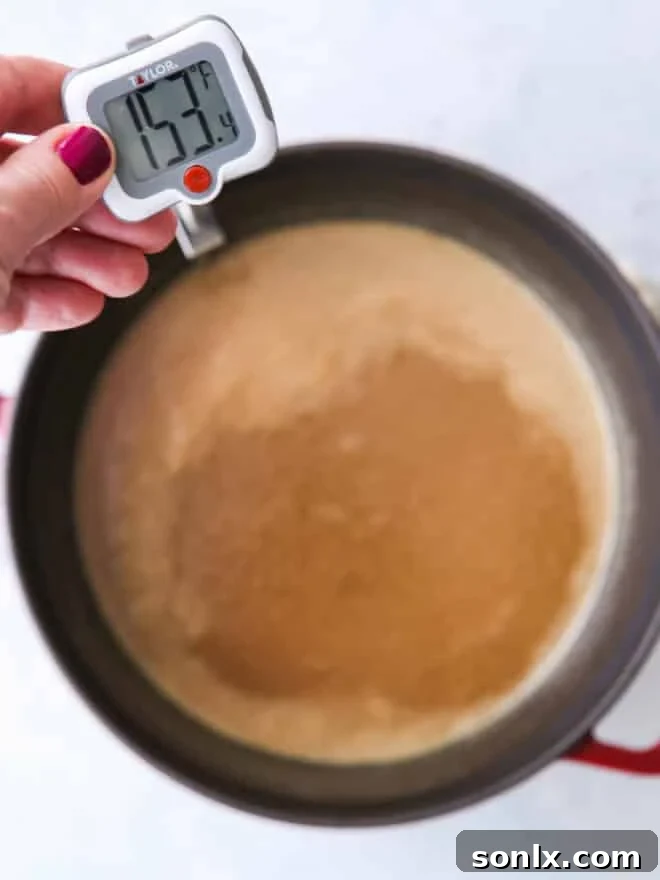
When using your candy thermometer, ensure the tip is submerged in the mixture but not touching the bottom of the pot, as this can give an inaccurate reading. Keep a watchful eye on the temperature as it rises, especially as it approaches the target of 238°F (soft ball stage). This precise temperature ensures that enough moisture has evaporated to allow the fudge to firm up, but not so much that it becomes grainy or brittle. Investing in and learning to properly use a candy thermometer is arguably the most important step towards becoming a successful fudge artisan.
Step-by-Step Guide: How to Make Brown Sugar Fudge
Crafting this brown sugar fudge is a rewarding process that comes alive with each carefully executed step. Follow these instructions closely, and you’ll be enjoying a batch of homemade penuche in no time. Remember, patience and attention to detail, especially regarding temperature, are your greatest allies.
- Combine and Cook the Base: Begin by combining the brown sugar, evaporated milk, and butter in a heavy-bottomed pot. The heavy bottom is essential for even heat distribution, preventing scorching. Place the pot over medium heat and stir constantly as the ingredients melt and come together. Continue to cook, stirring frequently to prevent sticking and ensure even cooking, until your candy thermometer precisely reaches 238°F (soft ball stage). This critical temperature dictates the final texture of your fudge, so do not rush this step.
- Beat in Vanilla and Powdered Sugar: Once the mixture hits 238°F, immediately remove it from the heat. Carefully pour the hot mixture into a heat-proof mixing bowl. Add the vanilla extract, which will release its aromatic essence into the warm fudge. Using an electric mixer (a hand-held mixer is highly recommended for control and ease), begin beating the mixture. Gradually add the sifted powdered sugar in small increments as you continue to beat. This process is vital for creating a smooth, creamy, and properly structured fudge. Continue beating until the mixture thickens and loses some of its glossy sheen, becoming more opaque and a little stiff.
- Fold in Walnuts (Optional): If you choose to include the delightful crunch of toasted walnuts, now is the time to add them. Once all the powdered sugar has been incorporated and the fudge is thick, gently fold in the chopped, toasted walnuts using a spoon or spatula until they are just evenly distributed throughout the mixture. Avoid overmixing once the nuts are added.
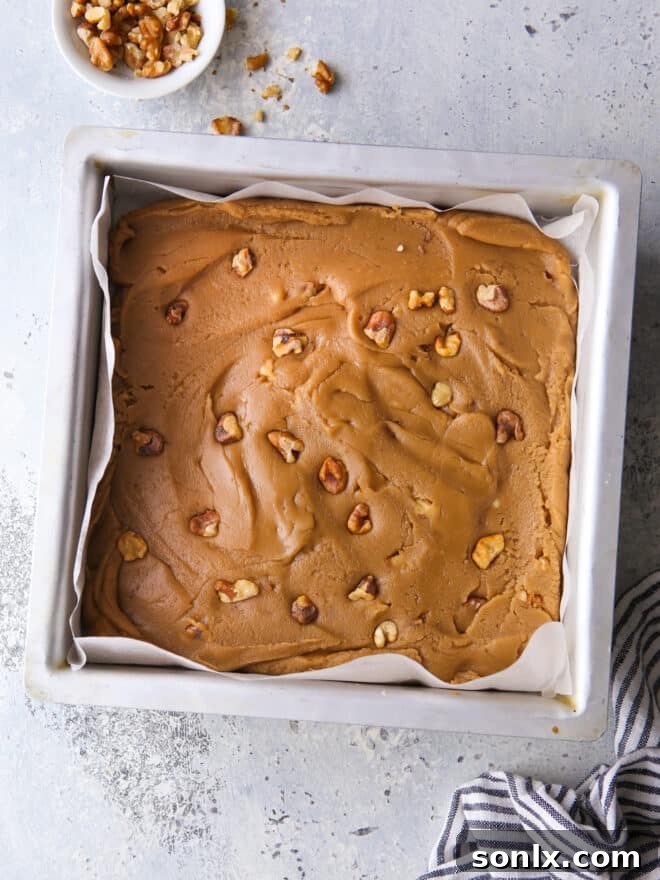
- Spread into Pan: Working quickly, as fudge sets rapidly, immediately transfer the mixture into a prepared 8-inch square pan. For easy removal, you can line the pan with parchment paper or wax paper, leaving an overhang on the sides to use as “handles.” Use an offset spatula or the back of a spoon to spread the fudge evenly into the pan.
- Allow to Cool and Set: The fudge now needs time to cool and fully set. This can take approximately 30 to 60 minutes at room temperature. For a quicker set, you can also chill it in the refrigerator for about 30 minutes. Ensure it is completely firm before attempting to slice it.
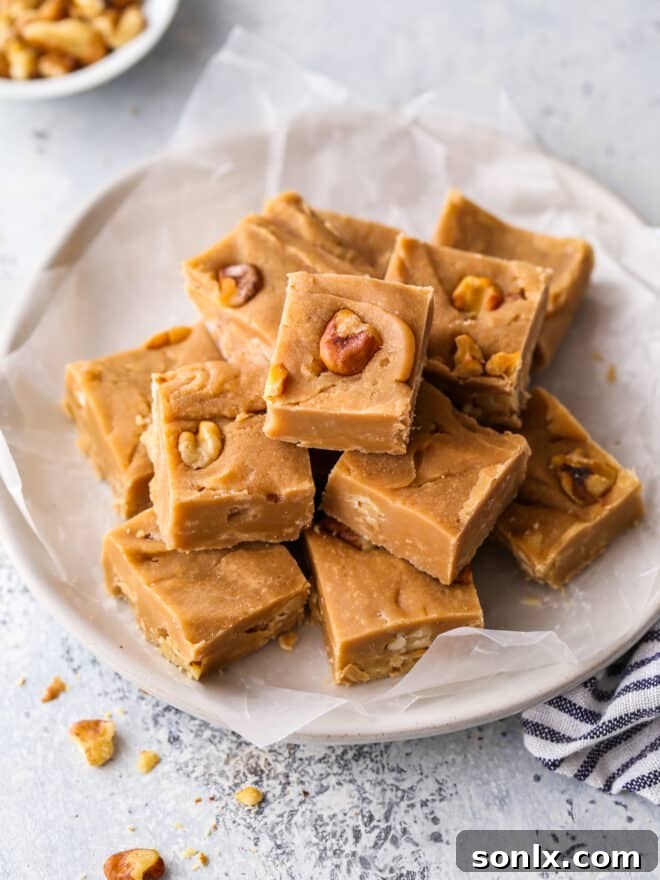
- Slice and Serve: Once completely cooled and firm, use a sharp knife to slice the fudge into small squares. Given its rich and sweet nature, I recommend cutting into smaller, bite-sized pieces—around 36 squares from an 8×8-inch pan is usually ideal. Arrange them beautifully on a platter and enjoy your perfectly crafted brown sugar fudge!
Expert Tips for Fudge Making Success
Making perfect brown sugar fudge, or penuche, is an art, but it’s an art made simple with a few key techniques and considerations. Here are some expert tips to ensure your fudge turns out flawlessly every time: creamy, smooth, and utterly delicious.
- Altitude Adjustment is Crucial: The target temperature of 238°F for the “soft ball stage” is for sea level. If you live at a higher altitude, you absolutely must adjust this temperature. Water evaporates more quickly at higher elevations, meaning your fudge will reach the desired consistency at a lower temperature. As a general rule, decrease the target temperature by 2°F for every 1,000 feet of elevation. For instance, living at 4,000 feet in Utah, I cook my sugar mixture to 230°F. Neglecting this adjustment is a common cause of hard, crumbly fudge.
- Understanding the “Soft Ball Stage”: Even with a thermometer, knowing what the “soft ball stage” looks like is invaluable for verification. This stage means that when you drop a small spoonful of the hot sugar mixture into a cup of ice water, it should form a soft, pliable ball that can be flattened easily between your fingers. It shouldn’t be sticky, nor should it be hard. This is your visual confirmation that the fudge has cooked just right.
- Troubleshooting Crumbly Fudge: If your fudge turns out crumbly and dry, it’s almost always an indication that the sugar mixture was cooked too long, and too much moisture evaporated. To prevent this, watch your candy thermometer meticulously as the mixture approaches the target temperature. Keep your stovetop on a consistent medium heat to allow for gradual heating, giving you ample time to react and remove it from the heat precisely when it’s ready. Don’t be tempted to crank up the heat to speed things up.
- The Best Mixer for the Job: While a stand mixer with a paddle attachment can work, I highly recommend using a hand-held electric mixer for beating the fudge after it comes off the heat. A hand-held mixer offers greater control and allows you to better feel the consistency of the fudge as it transforms. The vigorous beating is crucial for developing the small sugar crystals that give fudge its smooth, creamy texture. If you don’t have one, some good old-fashioned elbow grease with a sturdy spoon can also get the job done, though it will require more effort.
- Enhancing Flavor with Toasted Nuts: Adding nuts is entirely optional, but if you do, pre-toasting them makes a significant difference. Toasting walnuts (or pecans, which would also be fantastic!) brings out their natural oils, intensifying their nutty flavor and adding a more complex aroma. To toast, spread the chopped nuts in a single layer on a baking sheet and broil for 1-3 minutes, stirring once or twice. Watch them *very* closely, as nuts can go from perfectly toasted to burnt in seconds. Remove them from the oven as soon as they become fragrant and lightly golden.
- Proper Fudge Storage: To maintain its freshness, creaminess, and flavor, store your brown sugar fudge in an airtight container. It will keep beautifully at room temperature for a week or even longer. For extended storage, you can also wrap it tightly and freeze it for up to 2-3 months. Thaw at room temperature before serving for the best texture.
- Pan Preparation for Easy Removal: For the cleanest slices and easiest removal from the pan, lightly grease your 8×8-inch square pan with butter or cooking spray. For an even easier lift, line the pan with parchment paper or wax paper, ensuring there’s an overhang on two opposite sides. Once the fudge is set, you can simply lift it out of the pan using these overhangs before slicing.
More Delectable Candy Recipes to Explore
If you’ve enjoyed the sweet satisfaction of making this Brown Sugar Fudge, you’ll love venturing into other homemade candy creations. Here are a few more recipes to tantalize your taste buds and expand your confectionary skills:
- Salted Caramel Nut Brittle
- Peppermint Fudge (Frango Mint Chocolates Inspired)
- Salted Chocolate Truffles
- Classic English Toffee
Brown Sugar Fudge Full Recipe
Rating: 5 out of 5 stars (9 reviews)
Brown Sugar Fudge
36
pieces
15
mins
30
mins
45
mins
Pin Recipe
Leave a Review
Ingredients
- ½ cup + 2 tablespoons evaporated milk (150 ml)
- 2 cups packed light or dark brown sugar (425 grams)
- ¾ cup unsalted butter, cut into cubes (170 grams)
- ¼ teaspoon salt
- ½ teaspoon vanilla extract
- 1 cup powdered sugar, sifted (130 grams)
- ¾ cup toasted walnuts, chopped (optional) (85 grams)
Instructions
-
Combine the evaporated milk, brown sugar, butter, and salt in a heavy-bottomed medium saucepan. Place over medium heat and bring to a boil, stirring until smooth. Continue to simmer, stirring frequently, until a candy thermometer reaches 238°F (see Notes for altitude adjustments).
-
Remove from heat and pour into a heat-proof bowl. Add the vanilla and combine with a hand-held mixer. Add the powdered sugar in small additions while continuing to beat with the mixer. Mix until smooth and thick. If using, add the walnuts and mix until just combined.
-
Spread the fudge into an ungreased 8-inch square pan (or line with parchment or wax paper for easy removal). Let cool completely, about 1 hour, or chill in the fridge for 30 minutes until firm. Slice with a sharp knife into small squares. Store fudge in an air-tight container for several days.
Notes
Notes
- Temperature will need to be adjusted if you live at high altitude. Decrease temperature by 2°F for every 1,000ft of elevation. For example, if you live at over 4,000ft, cook your sugar to 230°F.
- If you do not have a hand-held mixer, a stand mixer fitted with a paddle attachment can be used. Mixing by hand with a sturdy spoon is also possible but requires more effort.
- To toast walnuts, spread them in a single layer on a sheet pan and set under the broiler for 1-3 minutes, stirring at least once. Keep a very close eye on the walnuts to prevent burning, and remove them from the oven when they are fragrant and start to turn lightly brown.
Recipe adapted from The Gourmet Cookbook.
Carbohydrates: 19 g,
Protein: 1 g,
Fat: 6 g,
Saturated Fat: 3 g,
Cholesterol: 11 mg,
Sodium: 24 mg,
Potassium: 39 mg,
Fiber: 1 g,
Sugar: 18 g,
Vitamin A: 127 IU,
Vitamin C: 1 mg,
Calcium: 23 mg,
Iron: 1 mg
American
Dessert
Annalise Sandberg
Have you tried this recipe? I’d love to hear about it! Leave a rating and review below, or take a photo and tag it on Instagram @completelydelicious with #completelydelicious.
This recipe was originally published in October 2013 and has been updated for clarity and comprehensive tips.
In conclusion, this brown sugar fudge recipe offers a delightful journey into classic candy making, culminating in a treat that’s both richly flavored and wonderfully satisfying. From its distinctive caramel notes to the optional, earthy crunch of walnuts, every element contributes to an unforgettable dessert experience. With the right tools and these detailed instructions and tips, you’re now equipped to create batches of perfect penuche that will impress family and friends alike. So, roll up your sleeves, gather your ingredients, and prepare to indulge in the sweet, comforting magic of homemade brown sugar fudge. Happy candy making!