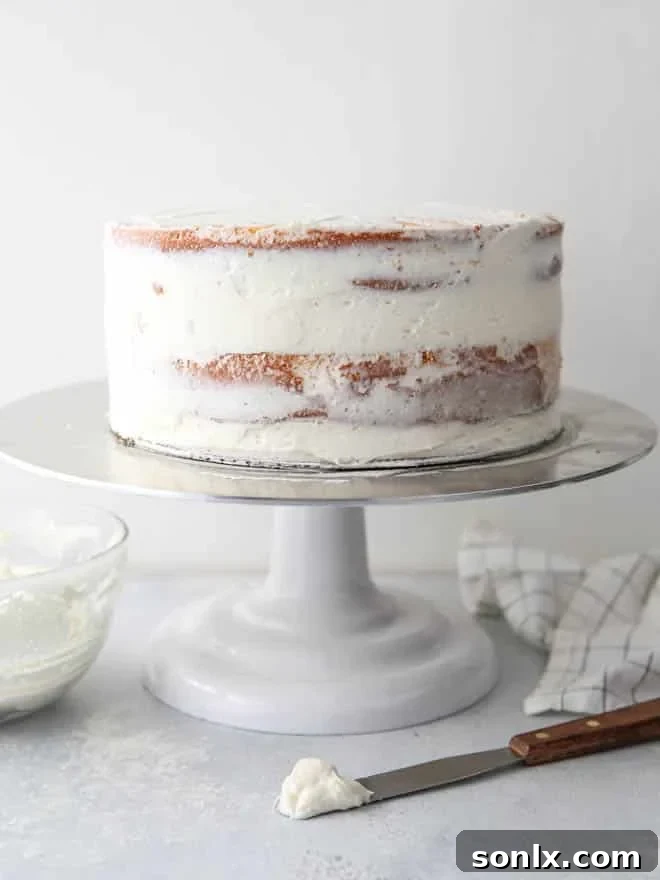
Have you ever dreamed of frosting a layer cake at home that looks like it came straight from a professional bakery? That pristine, smooth finish, those perfect edges, the elegant presentation – it might seem intimidating, but I’m here to tell you it’s entirely achievable for any home baker. This comprehensive guide will walk you through every step, turning what many consider a daunting task into a simple, enjoyable process. Get ready to elevate your homemade cakes from delicious to absolutely stunning!
For years, the idea of writing a detailed post on cake frosting felt overwhelming. There are countless brilliant bakers and professional decorators out there, sharing their intricate techniques. I’ve never worked in a commercial bakery or run a cake decorating business. However, I’ve spent countless hours in my home kitchen, baking for family and friends, learning through observation, and most importantly, through plenty of trial and error. And I realized, perhaps that’s my true strength – I’m just like you.
I’m a passionate home baker who has discovered simple yet effective tricks to make cakes more polished and impressive. Frosting a layer cake doesn’t require a culinary degree or expensive machinery. With a few basic tools and a clear understanding of the process, you can transform your home-baked creations from rustic to refined. This tutorial is packed with all the knowledge I’ve accumulated, designed to empower you to achieve beautiful results every time.
Come along, and let’s master the art of frosting together! You’ll be amazed at what you can create.
Why Mastering Cake Frosting Matters
A beautifully frosted cake isn’t just about aesthetics; it’s about the entire experience. It signals care, attention to detail, and makes any occasion feel more special. While the taste is paramount, the visual appeal often sets the first impression. Imagine presenting a towering, perfectly smooth layer cake at a birthday party or family gathering – it’s a showstopper that elicits gasps of delight and makes your baking efforts truly shine. Learning these techniques also opens up a world of creative possibilities, allowing you to personalize your cakes and express your unique style.
Essential Tools for Flawless Frosting
While you might think elaborate equipment is necessary, the truth is, a few specific, accessible tools can make a monumental difference in simplifying the task and perfecting your results. Here’s a breakdown of what you’ll need to set yourself up for success:
(Disclosure: This post contains affiliate links. If you make a purchase through these links, I may earn a small commission at no extra cost to you.)
- Prepared Cake Layers: The foundation of any great layer cake. For the best possible results, ensure your cake layers are completely cooled, and ideally, chilled. Chilling makes them firmer and much easier to handle, reducing the risk of tearing or crumbling. If your cakes have domes, gently level them using a serrated knife or a specialized cake leveler to create flat surfaces that stack neatly. Consistency in height across your layers is key to a stable and professional-looking cake. For guidance on preparing and storing layers, see my tutorial on how to make and store layer cakes ahead of time, and for achieving perfectly flat cakes, check out how to bake flat cake layers.
- Prepared Frosting: The right consistency of frosting is paramount. For a standard 8 or 9-inch layer cake, you’ll generally need about 4-5 cups of frosting. Buttercream, cream cheese frosting, or ganache are popular choices. Ensure your frosting is smooth, free of lumps, and at the right temperature – often slightly cooler than room temperature so it holds its shape but is still spreadable. If it’s too warm, it will be too soft; if too cold, it will be too stiff. You may need to add a touch of milk or cream to thin it slightly, or chill it briefly to firm it up.
- Prepared Filling (Optional): If you plan to fill your cake with something other than frosting, such as fruit preserves, lemon curd, chocolate ganache, or whipped cream, have it ready. Soft fillings add an extra layer of flavor and texture but require a sturdy frosting dam to prevent them from oozing out.
- A Turntable: This is a game-changer! While not strictly essential, a good turntable allows you to rotate your cake smoothly as you frost, making it infinitely easier to apply frosting evenly and achieve those coveted straight sides. I adore my sturdy Ateco turntable, but I used a more budget-friendly plastic turntable for years with excellent results. It’s truly one of the best investments for cake decorating.
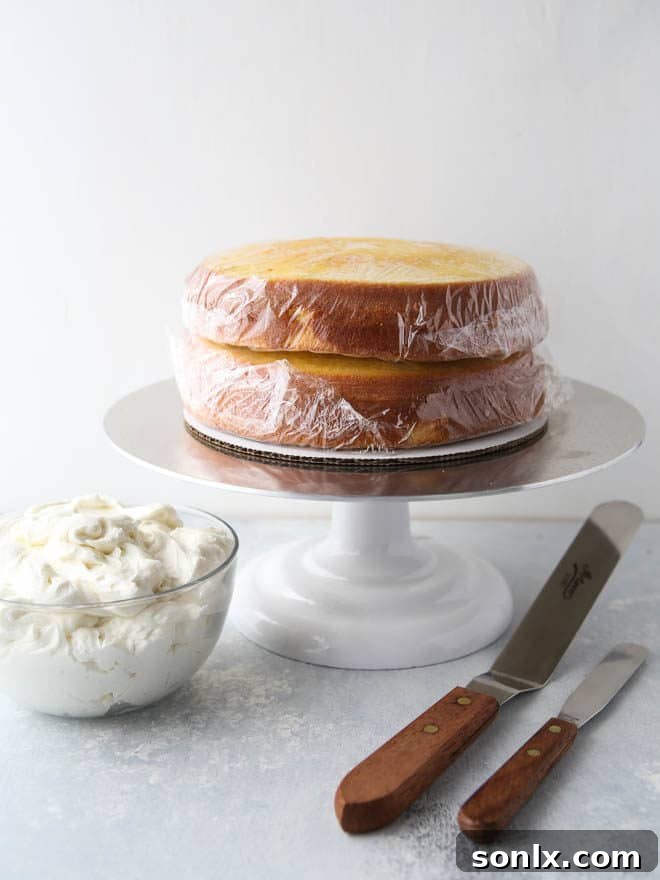
- Cardboard Rounds: These inexpensive discs are incredibly useful for handling and transporting your cake layers. Placing your cake directly on a cardboard round allows you to easily move it from the turntable to the fridge, or to a cake stand, without touching the delicate frosted surface. This minimizes potential damage and keeps your cake looking pristine. They also provide a stable base during frosting.
- Offset Spatula(s): If you invest in only one specialized tool for cake decorating, make it a set of offset spatulas. Their angled blade keeps your knuckles out of the frosting, making spreading much cleaner and easier. I highly recommend a set of three (small, medium, and large), as each size serves a different purpose – larger ones for initial spreading, smaller ones for detail work. Straight spatulas are also handy for specific tasks.
- Piping Bag and Tip (Optional but Recommended): While you can create a frosting dam with a spatula, a piping bag fitted with a round tip (like an Ateco #12) allows for a cleaner, more precise dam, especially beneficial for softer fillings. It’s also great for adding decorative borders later. Consider a piping bag and a round tip.
- Bench Scraper (Optional): Many professional bakers swear by a bench scraper for achieving perfectly smooth and straight sides. While an offset spatula can accomplish this, a bench scraper offers a rigid, flat edge that can provide an even more polished finish.
Note: For this tutorial, I used my favorite vanilla buttermilk cake recipe and a delightful whipped vanilla buttercream frosting.
The Art of Stacking and Filling Your Cake
Building a stable and delicious cake begins with careful stacking and filling. This stage sets the groundwork for a beautiful finish.
Step 1: Prepare Your Base
Place your first cake layer top side-down onto a cardboard round. The flat, bottom side of the cake now becomes the top of your initial layer, providing a perfectly level surface for your filling and the next cake layer. Position this cardboard round with the cake directly on your turntable (if using) or your final serving plate/cake stand. Using the turntable will significantly ease the frosting process.
Step 2: Add Your Filling (and the Critical “Frosting Dam”)
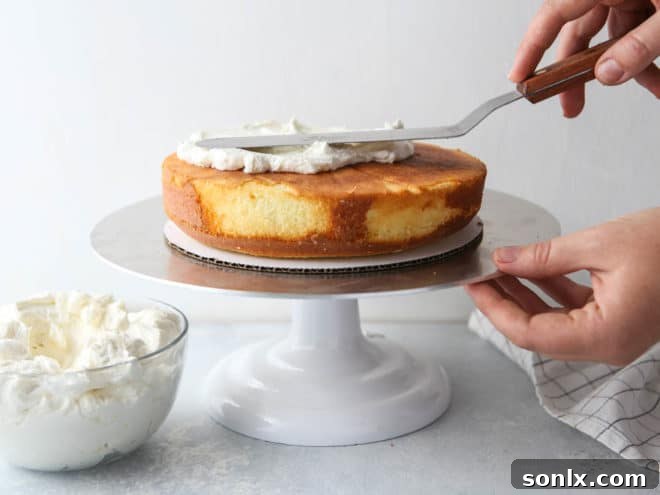
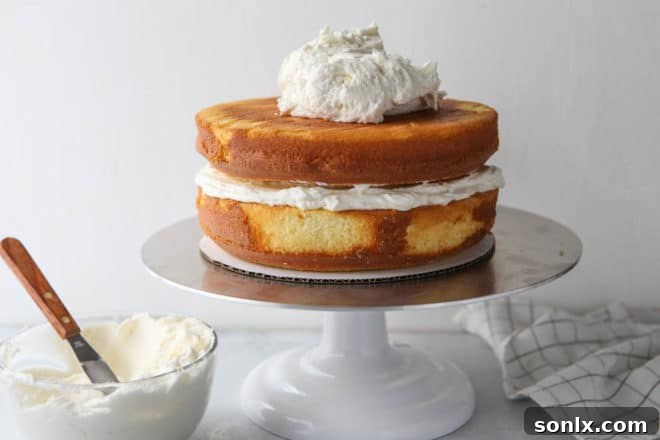
Scoop a generous amount of frosting or your chosen filling onto the center of the first cake layer. Using an offset spatula, spread it evenly to the edges. If you’re using a soft or runny filling like fruit preserves, lemon curd, or a light whipped cream, it’s absolutely crucial to build a “frosting dam” first. To do this, pipe or spread a sturdy ring of frosting around the very edge of the cake layer, creating a raised barrier. This dam will act as a protective wall, holding your soft filling securely in place and preventing it from squishing out the sides when subsequent layers are added. Without it, your cake can become unstable and messy.
Step 3: Build Your Layers
Carefully place your next cake layer on top of the filling, again, ideally top side-down for a flat surface. Gently press down to ensure it’s level and settled. Repeat the process of spreading frosting or filling and adding layers until your cake is built to your desired height. You can keep it simple with just two layers, or create a magnificent taller cake with as many layers as you’d like. For even more impressive height, consider slicing your cake layers horizontally in half to create thinner, more numerous layers. This technique requires a steady hand and a good serrated knife or cake leveler for consistent results.
The Indispensable Crumb Coat: Your Secret to a Professional Finish
The crumb coat is arguably the most important, yet often overlooked, step in achieving a beautifully frosted cake. It’s a thin, preliminary layer of frosting applied to the entire cake, and it truly is a game-changer. Its primary purpose is to seal in any loose crumbs, preventing them from mixing with your final layer of frosting. It also helps to even out the surface of your cake, providing a smooth, stable canvas for the final, decorative coat. This way, your finished cake will be flawlessly smooth, uniform, and completely crumb-free.
Step 4: Apply the Crumb Coat with Precision
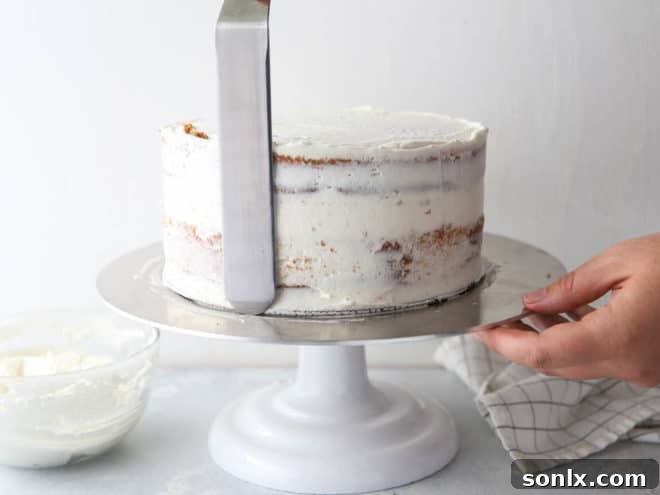
Take a small amount of your prepared frosting – typically 1-2 cups, depending on your cake size – and if it’s very thick, you might thin it slightly with a teaspoon of milk or cream to make it more spreadable. Using a medium offset spatula, apply a very thin, almost translucent layer of frosting over the entire cake, including the top and sides. Start with the top, spreading from the center outwards, then move to the sides. The goal here isn’t perfection, but rather to create a sticky surface that traps all crumbs.
Work quickly and gently, filling in any small gaps between layers and doing your best to even out any uneven spots. Don’t worry if it looks a little messy; that’s normal for a crumb coat. To smooth the sides, hold your offset spatula perpendicular to the turntable or cake stand, applying light, consistent pressure as you slowly rotate the cake. This motion helps to create a relatively even surface.
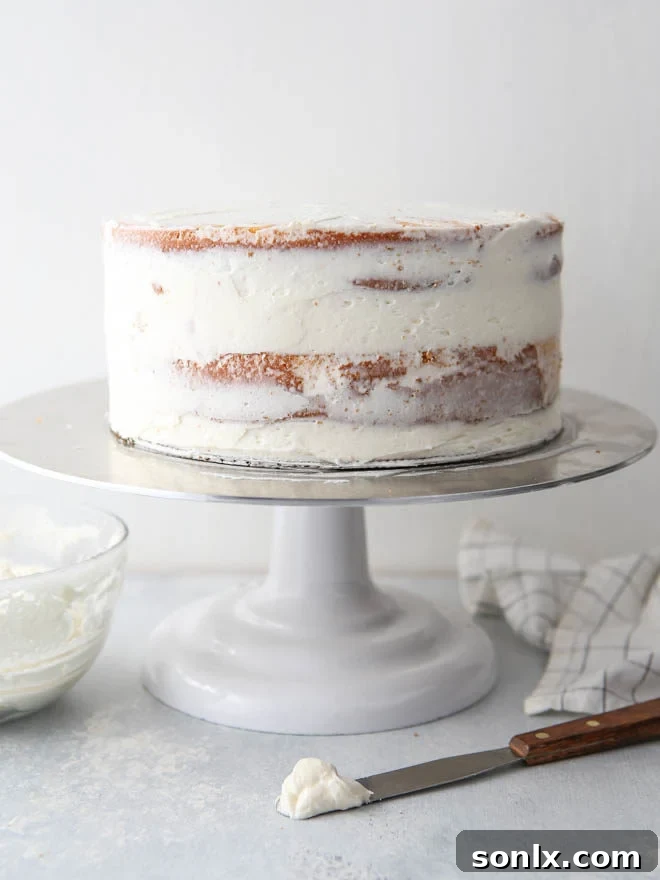
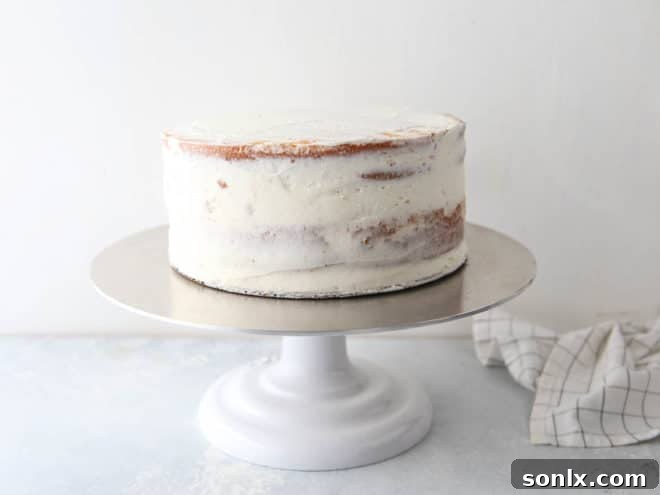
Note: If you’re a fan of the rustic “naked cake” or “semi-naked cake” look, where the cake layers are partially visible, then once you’ve applied this thin crumb coat, you’re essentially done with the frosting! Simply chill the cake to set this light layer, then you can decorate and serve.
Step 5: Chill to Set the Crumb Coat
Once the crumb coat is applied, it’s crucial to chill the cake for at least 20-30 minutes. This allows the thin layer of frosting to firm up completely, trapping all those pesky crumbs and creating a stable, smooth exterior. When you apply your final coat, it will glide on effortlessly without picking up any loose cake bits.
Note: Fitting a whole frosted cake and its stand into a fridge can be challenging. This is precisely why using cardboard cake rounds is so beneficial. They make transporting your layered cake in and out of the fridge a breeze, ensuring your crumb coat (and later, your final frosting) sets perfectly without getting bumped or smudged.
Applying the Final Coat of Frosting for a Smooth Finish
With your crumb coat chilled and set, you’re now ready for the satisfying process of applying the final, generous layer of frosting. This is where your cake truly begins to take on its polished, professional appearance.
Step 6: Generous Application and Smoothing
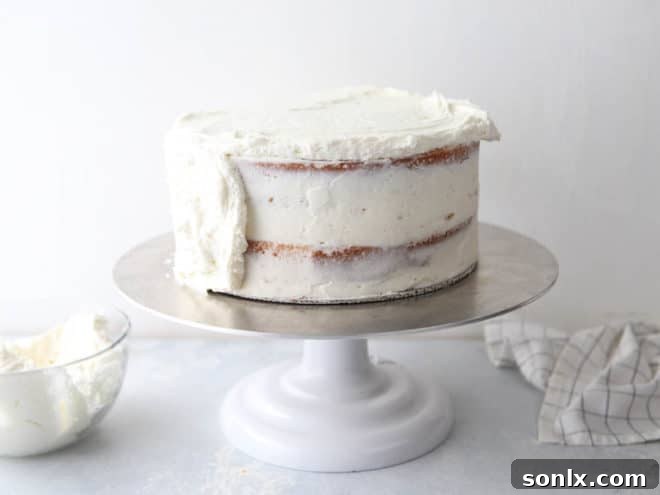
Scoop a substantial amount of your remaining frosting onto the top of the cake. Unlike the crumb coat, you want to apply a thick, even layer here. Using your large offset spatula, spread the frosting over the top, then push some of it over the edges to begin covering the sides. Continue to add frosting to the sides, ensuring the entire cake is generously covered with a thick, even layer. Don’t worry about it being perfectly smooth yet; focus on getting enough frosting on the cake to work with.
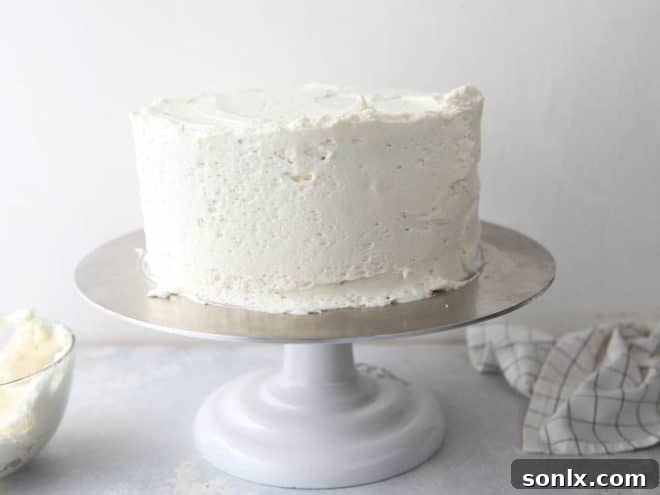
Once the cake is completely enveloped in frosting, it’s time to smooth it out. For the sides, hold your offset spatula or a bench scraper perfectly perpendicular to your turntable or cake stand. Apply light, consistent pressure against the cake and slowly rotate the turntable. Use long, steady strokes, working your way around the cake multiple times. Each pass should remove excess frosting and gradually create a clean, smooth, and straight finish. If you encounter any gaps, add a little more frosting to that spot and smooth again. Wipe your spatula clean frequently for the best results. While I’ve always used an offset spatula, many bakers find a bench scraper incredibly effective for achieving razor-sharp edges and flawlessly smooth sides. Experiment to see what works best for you!
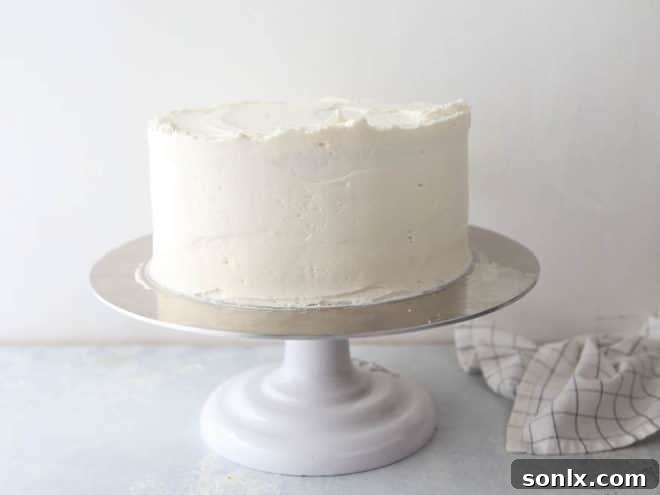
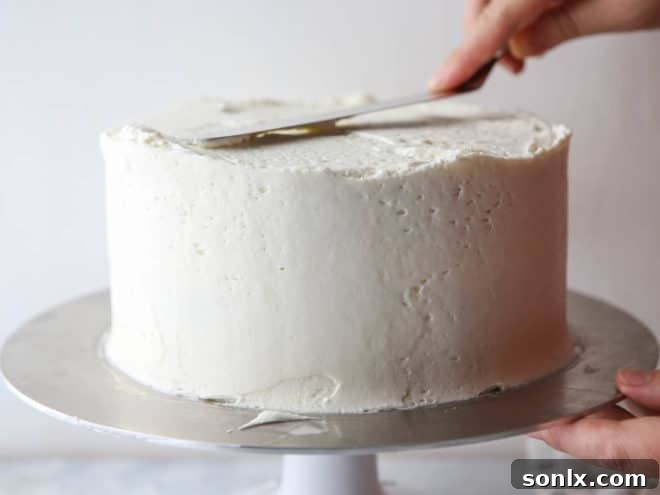
To smooth the top of your cake, gently take the edge of your clean offset spatula and drag it from the outside edge of the cake inward towards the center. This motion pulls the slight overhang of frosting from the sides inward, creating a crisp top edge. Wipe your spatula clean after each swipe, rotate the cake slightly, and repeat this motion until the entire top surface is perfectly smooth and level. Consistent cleaning of your spatula prevents frosting buildup and unsightly drag marks.
Decorate, Chill, and Serve Your Masterpiece
The hard work is done! Now comes the fun part: adding your personal touch and preparing your beautifully frosted cake for its moment in the spotlight.
Step 7: Unleash Your Creativity with Decorations
Your perfectly smooth, frosted canvas is now ready for decoration! This is where you can truly express your creativity. Consider adding colorful sprinkles for a festive look, piping elegant borders or swirls with a piping bag and decorative tips, arranging fresh berries or edible flowers, drizzling with chocolate ganache, or topping with delicate chocolate shavings. The possibilities are endless.
If you used a turntable and a cardboard round, you can now carefully slide your completed cake onto your desired cake stand or serving plate. The cardboard round makes this transfer effortless and protects your beautifully frosted exterior. Alternatively, you can wait until you’re ready to serve before making the final transfer.
Step 8: Chill for Perfection and Clean Slices
Before slicing into your magnificent creation, it’s vital to chill the cake for at least 30 minutes. This allows the final layer of frosting to firm up, ensuring clean, sharp slices that hold their shape. If you’re planning to transport your cake, extend the chilling time to at least 1 hour, or even longer, to make sure the frosting is as firm and stable as possible. Remove the cake from the fridge just before you head out.
I personally prefer to store all my layer cakes in the refrigerator. This not only keeps the frosting perfectly in place but also helps to preserve the freshness and protect the cake from ambient heat or humidity. When you’re ready to serve, take the cake out of the fridge about 20-30 minutes beforehand. This allows the frosting to soften slightly to a more pleasant room temperature texture, ensuring every bite is absolutely delicious.
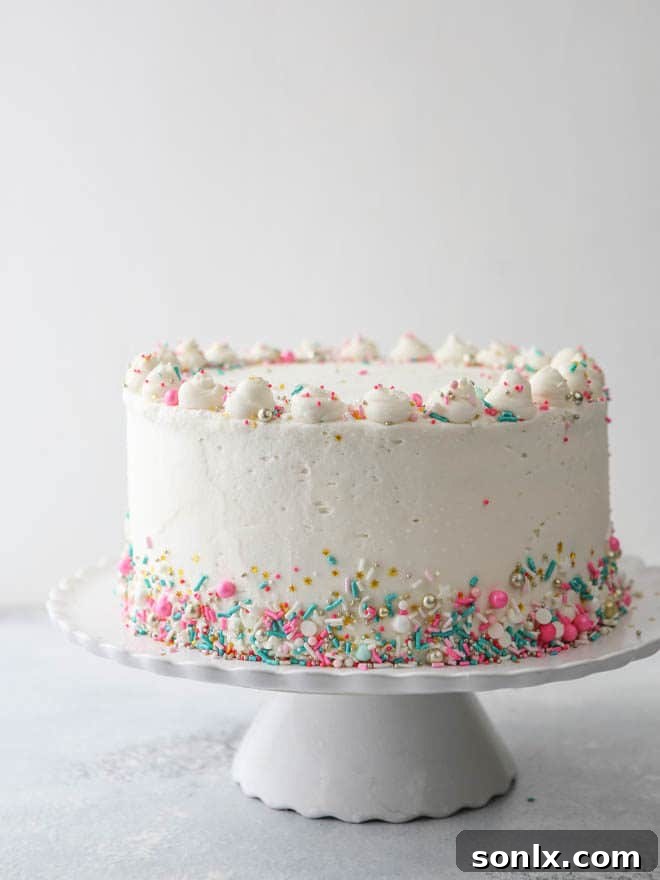
And there you have it! You’ve successfully learned how to frost a layer cake like a pro, turning simple ingredients into a breathtaking dessert. It’s all about patience, practice, and understanding these key techniques. Don’t be discouraged by initial imperfections; every cake is a learning opportunity.
Do you have any tried and true frosting tips or secret tools that you’ve discovered? I’d love to hear about them! Share your insights and experiences in the comments below, and let’s continue to learn and grow together as home bakers. Happy frosting!
My Favorite Cake Frosting Tools
These are some of the essential tools that have made my cake frosting journey so much smoother and more enjoyable. They are highly recommended for any aspiring home baker looking to achieve professional-looking results.
- Ateco Revolving Cake Decorating Stand: A sturdy, smooth-spinning turntable is indispensable for even frosting application.
- Wilton Cake Leveler: For perfectly flat cake layers, which are crucial for stable, even stacking.
- Offset Spatula Set (Various Sizes): A must-have for spreading frosting smoothly and easily.
- Stainless Steel Bench Scraper: Excellent for achieving ultra-smooth sides and sharp edges on your cakes.
- Disposable Piping Bags and Round Tips: For creating frosting dams and elegant decorative accents.